


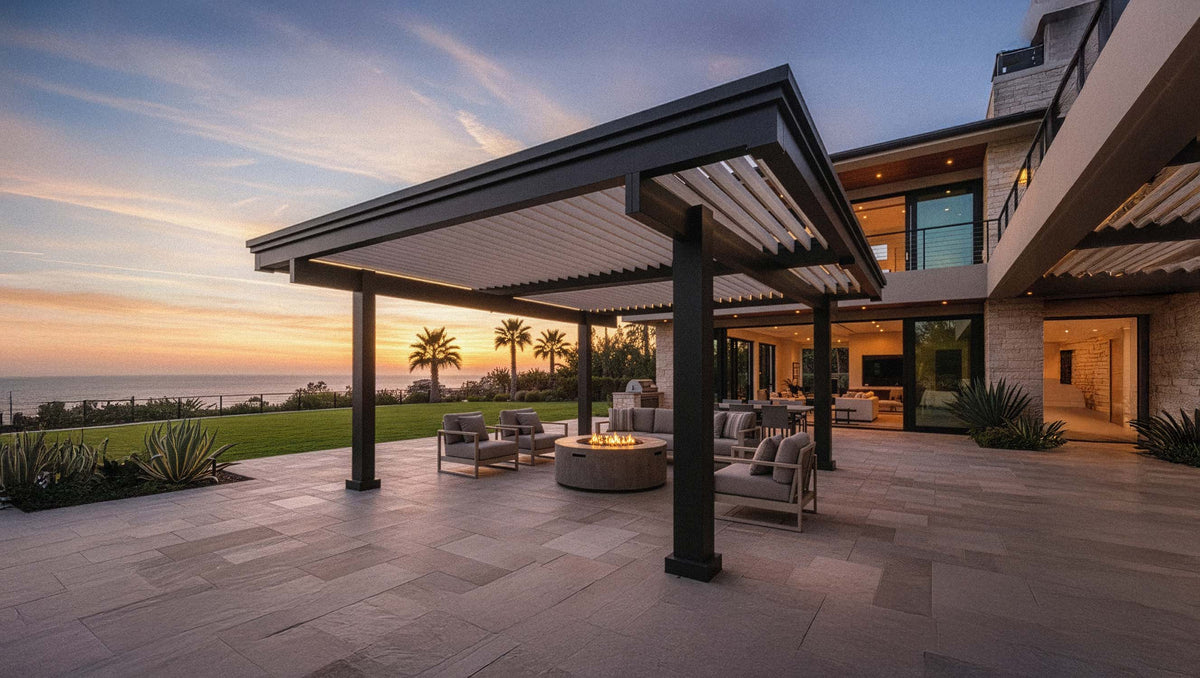
If you have been searching for ways to make your backyard or patio more usable, you have probably come across the word "pergola." But what is a pergola, exactly? And how is it different from a gazebo, a pavilion, or just a fancy roof over your deck?
This guide breaks down everything you need to know. We will cover what a pergola is, where the word comes from, the different types available today, how much they cost, and how to pick the right one for your space. Whether you are just starting to research outdoor structures or you are ready to buy, this is the starting point.

Table of Contents
Pergola Definition and Origin
A pergola is a garden feature forming a shaded walk or passageway of columns that support beams and a roof of rafters and trelliswork grown over with climbing plants. A pergola definition is simple: a pergola is a structure used to form a shaded area, with partial or full roofing, depending on the roofing style.
The term pergola actually originates from the Latin pergula, meaning “a projecting eave or a structure attached to a building”. In Roman times, pergulas were walkways in gardens and courtyards lined with grapevines. The idea was to construct a frame, train vines or other climbing plants to grow across the top, and voilà! You have a shaded outdoor area.
In Italian Renaissance gardens, pergolas were typically large frames covered with vines or roses. They were often used as an attractive walkway with plants trained overhead.
In the present, the definition of a pergola has grown. Now, pergolas include classic open-lattice wooden pergolas as well as fully motorized aluminum pergolas with adjustable louvered roofs that can be opened and closed with the simple touch of a button. Still, a pergola is a freestanding or wall-mounted structure that outlines a living space. Yet the technology and material choices are a far cry from ancient grapevines and pergolas.
What defines a pergola? Two primary characteristics. First, a pergola has an open roof or a partially open roof (modern pergolas can be completely closed). Second, pergolas are usually rectangular and freestanding or attached to a house. The combination of these two features differentiates pergolas from gazebos, pavilions, and arbors (see below).
Parts of a Pergola
While you’re deciding which one to buy, you might want to learn the parts of a pergola. From a $500 wood pergola kit to a $25,000 motorized aluminum pergola system, all of them have a few things in common. Here are the roles of each piece.
Posts (Columns)
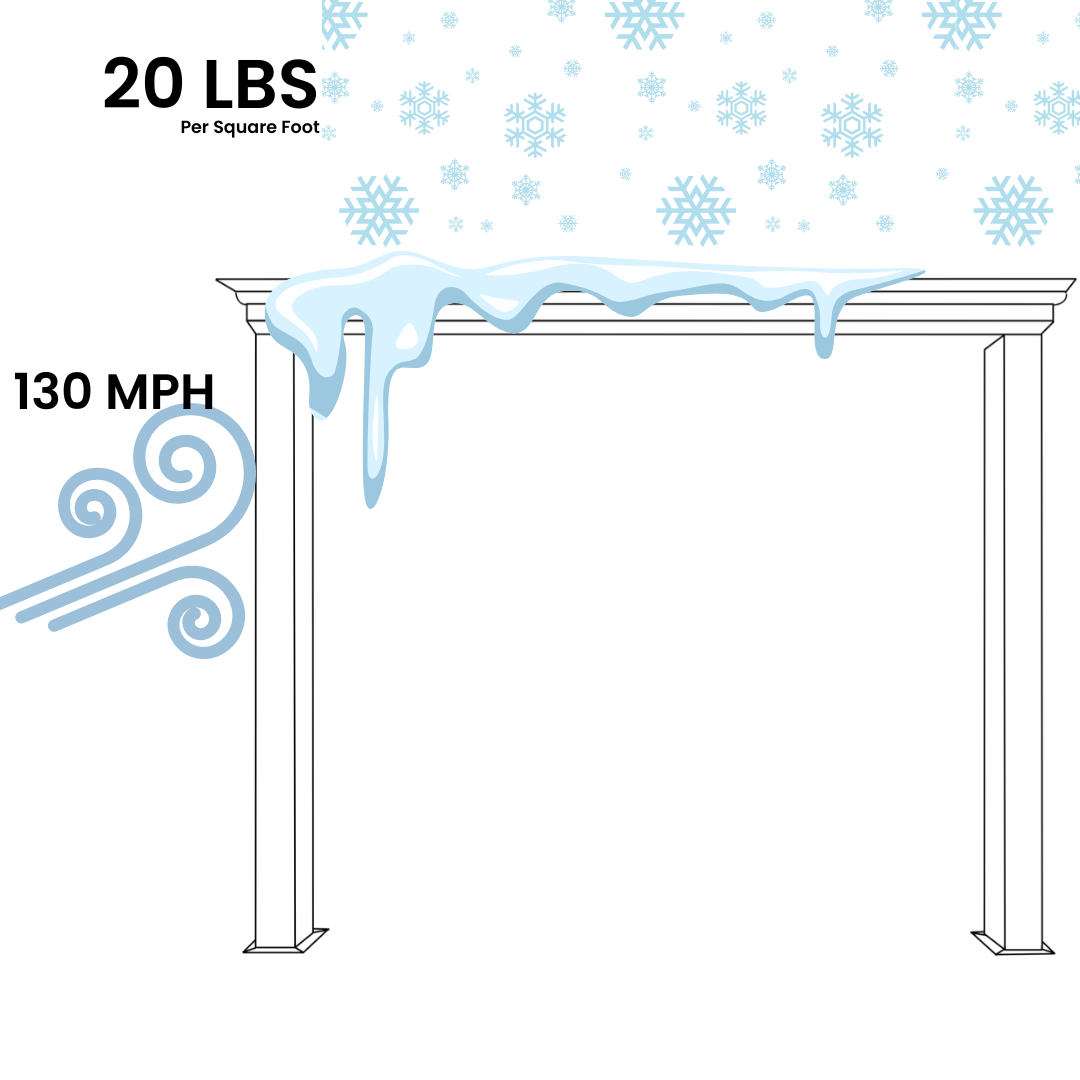
The vertical supports that hold everything up. Most pergolas use four posts, though larger structures may use six or more. Posts are typically anchored to a concrete pad, deck, or footing. The size and material of the posts determines how much weight the structure can support and how well it handles wind. For reference, a commercial-grade aluminum pergola post can be significantly thicker and heavier than a standard wood post, which directly affects stability.
Beams
The main horizontal members that run across the top of the posts, connecting them. Beams carry the load of the rafters and roof system above. On a standard pergola, you will usually see two beams running parallel to each other across the width of the structure. The beam size matters: larger beams mean greater load capacity, which is important if you live in an area with heavy snow or high winds.
Rafters (Purlins)
The secondary horizontal members that sit on top of the beams, running perpendicular to them. On a traditional open pergola, the rafters are the topmost element, creating a ladder-like pattern across the roof. They provide partial shade and are often the structural element that defines the classic pergola look. On louvered or solid-roof pergolas, the rafters support the roof panels or louver system above.
Louvers or Slats
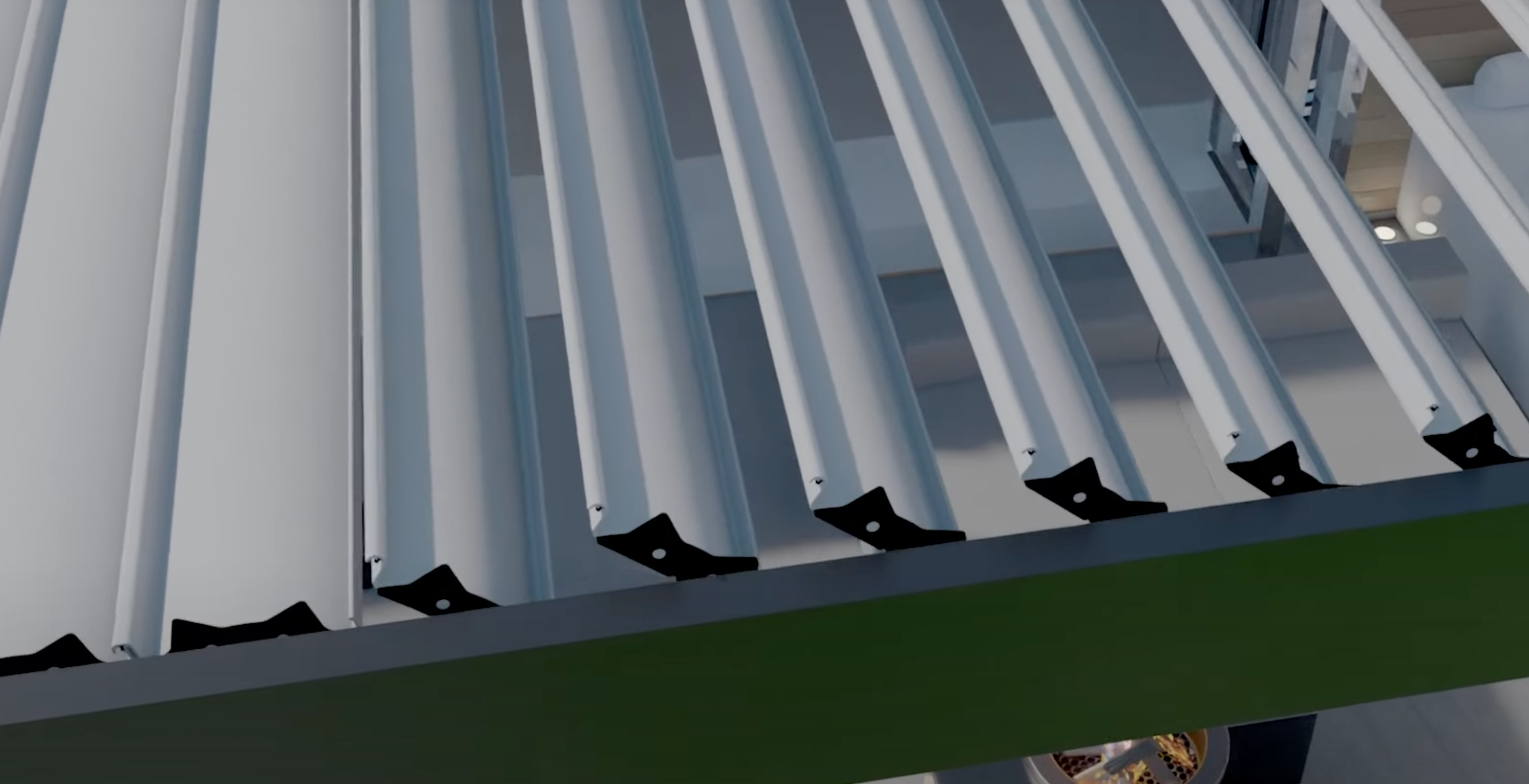
The roof elements that sit on top of (or replace) the rafters. On a traditional pergola, these are fixed slats or lattice panels. On a louvered pergola, these are adjustable blades that rotate to control how much sunlight, shade, and rain gets through. Motorized louvers rotate via remote control and can close completely to create a watertight seal or open fully for maximum sunlight.
Footings and Anchors
The connection point between the pergola posts and the ground. Footings can be concrete piers poured below the frost line, surface-mounted base plates bolted to an existing concrete pad, or post anchors embedded in a deck. The type of footing you need depends on your local building codes, the size of the pergola, and what surface you are mounting to. This is one of the most important parts of the installation because it determines how well the pergola handles lateral forces like wind.
Integrated Gutter System
Not all pergolas have this, but it is a key feature on modern louvered and solid-roof pergolas. A built-in gutter system channels rainwater from the roof down through the posts and away from the structure. Without this, water pools on the roof or sheets off the sides. On higher-end aluminum pergolas, the gutter is completely hidden inside the frame, so you get rain protection without visible downspouts.
Optional Accessories
Many modern pergolas support add-ons like ceiling fans, LED lighting strips, outdoor speakers, heaters, and retractable screens or curtains. These accessories mount to the beams or posts and let you customize your outdoor space for different seasons and uses.
Types of Pergolas
Not all pergolas are created equal. The type you choose depends on how much coverage you need, what climate you live in, your budget, and how you plan to use the space. Here is a breakdown of the five main types of pergolas available today.
| Type | Roof Style | Coverage | Best For | Price Range |
|---|---|---|---|---|
| Louvered (Adjustable) | Motorized rotating louvers that open and close | 0% to 100% (fully adjustable) | Year-round use, rain protection, maximum flexibility | $8,000 - $25,000+ |
| Fixed Roof (Solid Panels) | Permanent solid roof panels (polycarbonate, metal, or glass) | 100% (always covered) | Full rain and sun protection, outdoor kitchens | $5,000 - $20,000 |
| Lattice / Open (Traditional) | Fixed open rafters or lattice panels | 20% - 50% (partial shade) | Decorative use, vine growing, mild climates | $1,500 - $8,000 |
| Retractable Canopy | Fabric canopy that slides along tracks on the frame | 0% to ~90% (adjustable, not watertight) | Budget-friendly shade, casual use | $2,000 - $7,000 |
| Gable / Peaked | A-frame or peaked roof with open or closed panels | 80% - 100% | Traditional aesthetic, rain runoff, taller clearance | $4,000 - $15,000 |
Louvered Pergolas: The Modern Standard
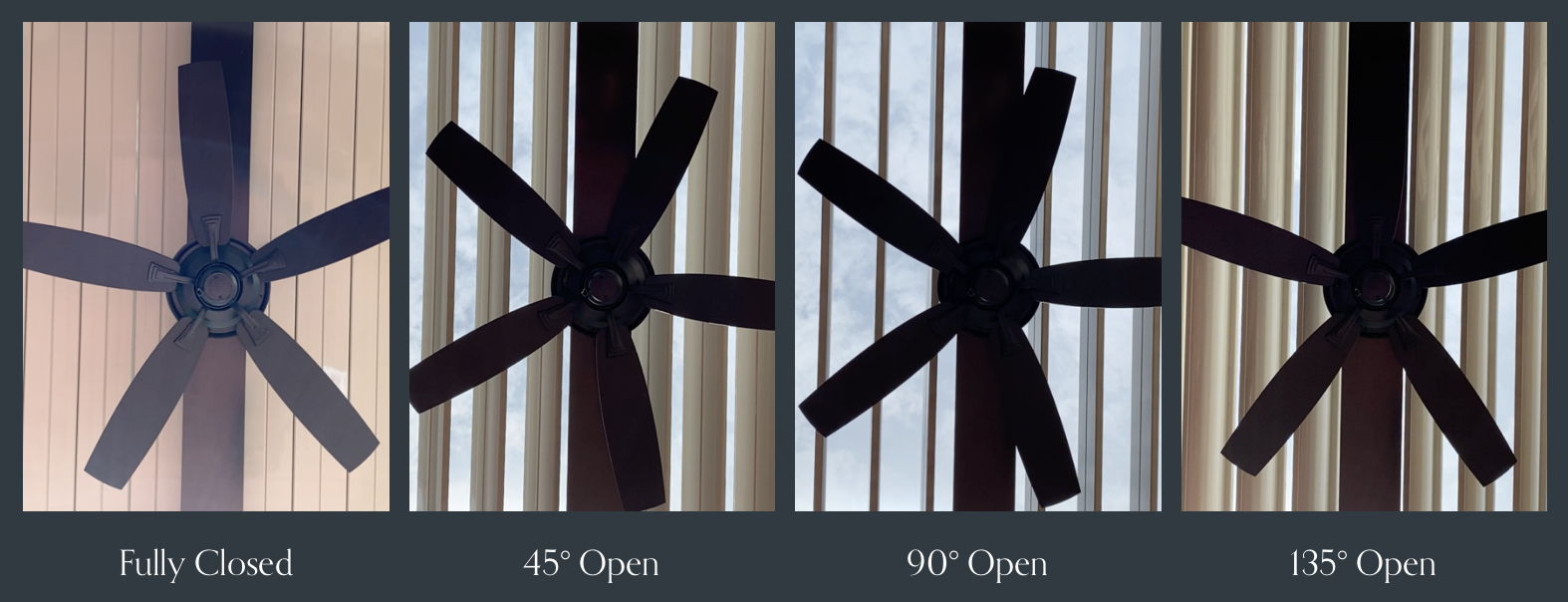
A louvered pergola offers the ultimate flexibility for your outdoor space. Louvers (the adjustable slats on the roof) can be opened fully, closed fully, or adjusted to any position in between to deliver whatever combination of sunlight, shade, or rain protection you desire. Typically, louvered pergolas are motorized and operated with a remote, wall switch, or smartphone app.
In the closed position, the louvers provide a watertight roof and rain is diverted by a built-in gutter that is an integral part of the frame. In the open position, sunlight and fresh air pour in. This makes the louvered pergola the most versatile for homeowners who want to use their space year round, in all weather conditions. To learn more about louvered pergolas, read our louvered pergola guide.
Fixed Roof Pergolas
A fixed roof pergola is just that. Instead of louvers, it has solid panels that are fixed in place. You’ll always have 100% coverage from the rain and sun, but you won’t have the option to allow sunlight to filter through or to completely open up the roof. A fixed roof pergola may be a better option for an outdoor kitchen where you need consistent coverage, but a louvered roof pergola offers more versatility.
Lattice and Open Pergolas
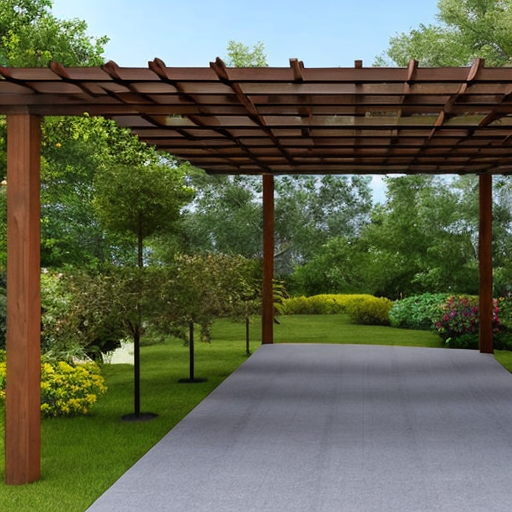
This is the classic pergola most people envision: a simple structure of beams and rafters with no roof at all. The open rafters offer some shade (about 20-50%, depending on the spacing and width), and many owners train vines such as wisteria or bougainvillea to grow over the top for more shade. This is the least expensive type but provides no rain cover and little shade.
Retractable Canopy Pergolas
These are the pergolas that have a fabric cover on them that rolls back and forth on a track. You can open it up for shade or roll it back for full sun. Less expensive than the louvered versions, they have some longevity issues with the fabric, will not hold up to pounding rain, and not ideal for windy and snowy conditions. Think of this as a fancy patio umbrella.
Gable / Peaked Pergolas
A gable pergola has a roof with a pitch that creates an A-frame effect, meeting at a point in the middle. This is a popular choice for traditional or colonial-style houses. The sloping shape ensures rainwater runs off and allows for greater head height in the middle. They can have open or closed roofs and may be made of wood or vinyl.
Pergola vs Gazebo vs Pavilion vs Arbor
One of the most frequently asked questions is pergola vs. ____. There are so many terms thrown around so often that I thought a simple comparison would be helpful.
| Feature | Pergola | Gazebo | Pavilion | Arbor |
|---|---|---|---|---|
| Roof Type | Open, louvered, or solid (varies by type) | Fully enclosed solid roof | Fully enclosed solid roof | Open lattice or arched top |
| Shape | Rectangular (most common) | Round, hexagonal, or octagonal | Rectangular or square | Narrow archway (walkthrough) |
| Size Range | 8x8 ft to 20x40 ft+ | 8x8 ft to 16x16 ft | 10x10 ft to 30x50 ft+ | 3x3 ft to 6x8 ft |
| Cost Range | $1,500 - $25,000+ | $3,000 - $15,000 | $5,000 - $30,000+ | $200 - $3,000 |
| Best For | Patio living, dining, outdoor kitchens, pool areas | Garden focal point, small gatherings | Large events, outdoor kitchens, commercial use | Garden entrance, walkway accent, wedding backdrop |
| Permit Usually Needed? | Often yes (depends on size and locality) | Usually yes | Almost always yes | Rarely |
Pergola: Of all these, a pergola is the most versatile. It can be open, semi-open, or fully covered, based on the type of roof you choose. Pergolas can serve as either attached (anchored to your house) or freestanding pergolas and are offered in the broadest array of shapes and sizes. A modern louvered pergola offers all of the above three in one: openness when you desire it, full protection when you require it.
Gazebo: A gazebo is a circular or polygonal structure with a solid roof that’s fully covered, and open sides or screens. A gazebo is usually situated independently in the middle of a yard or garden. They make for a lovely focal point for a garden, but are generally smaller and less flexible than pergolas.
Pavilion: A pavilion is a rectangular gazebo with a completely solid roof. A pavilion is designed for large groups of people and for outdoor entertaining. A pavilion has a completely covered roof with no options to open up any part of it. Pavilions are the most costly structures and most likely will need a building permit.
Arbor: An arbor is a small, narrow, arch-shaped structure designed as a passageway or entrance to a garden. Arbors are decorative, not functional living spaces. They are the simplest and least expensive of these outdoor structures.
Read our pergola vs gazebo comparison page for more information.
Pergola Materials Compared
Pergola material is one of the more important decisions you will make regarding your pergola, because it will influence the lifespan, maintenance, style, and price of your pergola. The five most popular pergola materials are analyzed below.
| Material | Durability | Maintenance | Cost | Look |
|---|---|---|---|---|
| Aluminum | Excellent. Will not rot, rust, warp, or crack. Lifetime-rated with proper powder coating. | Very low. Occasional rinse with a hose. No staining, sealing, or painting needed. | $$$ ($8,000 - $25,000+) | Modern, clean lines. Powder coat available in multiple colors. Flat ceiling design on premium models. |
| Wood (Cedar/Redwood) | Good when maintained. Naturally rot-resistant but will weather, crack, and gray over time. | High. Needs staining or sealing every 1-2 years. May need board replacement over time. | $$ ($3,000 - $12,000) | Warm, natural, traditional. Beautiful when fresh but grays and weathers if not maintained. |
| Vinyl | Moderate. Will not rot but can yellow, crack in extreme cold, and become brittle over time. | Low. Rinse to clean. No painting or staining needed. | $$ ($2,500 - $8,000) | Clean, white or light colors. Can look plastic. Limited color options. |
| Steel | Very strong but prone to rust if the coating is damaged. Heavy. | Moderate. Needs rust prevention and touch-up painting when scratched. | $$$ ($5,000 - $20,000) | Industrial, modern. Can be powder coated. Very strong visual presence. |
| Fiberglass | Good. Resists rot and insects. Lighter than aluminum or steel. | Low to moderate. May need repainting over time. | $$$ ($5,000 - $15,000) | Can mimic wood grain. Available in various colors. Smooth, consistent finish. |
Why Aluminum Has Become the Go-To Material
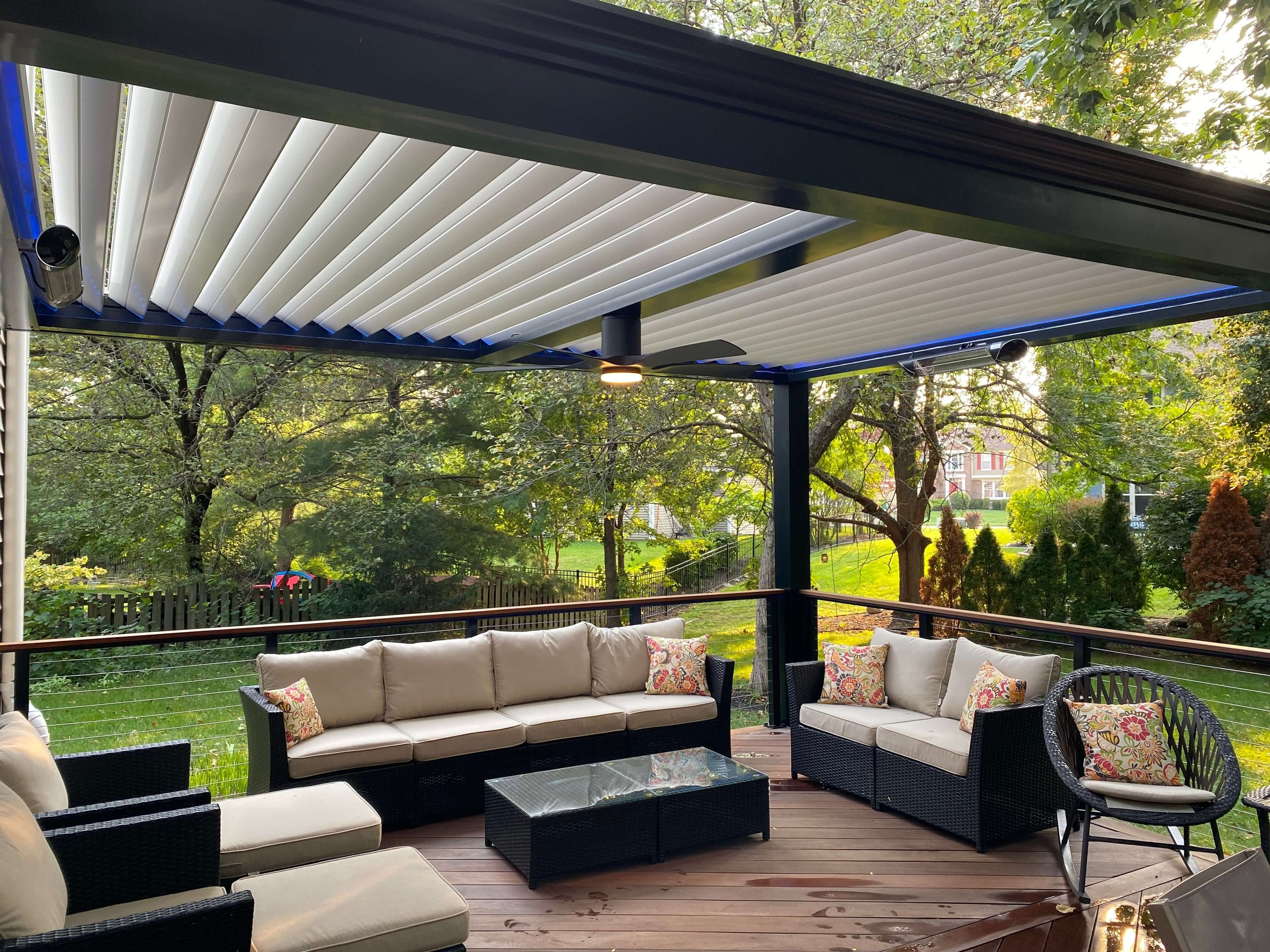
Over the past several years, aluminum has emerged as the preferred material for premium pergolas, and for good reason. Aluminum does not rot, does not rust, does not warp, and does not need regular maintenance. A high-quality powder coat (like the ElectroLayer coating process used by The Luxury Pergola) protects the finish from fading, scratching, and UV damage for the life of the structure.
Aluminum is also the only material that supports motorized louvered roof systems effectively. The precision required for louvers that rotate and seal watertight demands tight manufacturing tolerances that wood and vinyl simply cannot match. And because aluminum can be extruded into complex shapes, manufacturers can build integrated gutter systems, wire channels for electronics, and flat-ceiling profiles directly into the frame.
The tradeoff? Aluminum pergolas cost more upfront than wood or vinyl. But when you factor in the maintenance savings (no staining, no sealing, no board replacement) and the dramatically longer lifespan, the total cost of ownership often works out in aluminum's favor. For a detailed comparison, see our aluminum pergola comparison.
How Much Does a Pergola Cost?
Pergola costs vary widely based on the type, material, size, and whether you DIY or hire a contractor. Here is a realistic breakdown of what you can expect to spend.
| Pergola Type | Small (8x10 - 10x10) | Medium (10x13 - 12x16) | Large (14x20+) |
|---|---|---|---|
| Wood (DIY Kit) | $1,500 - $4,000 | $4,000 - $8,000 | $8,000 - $15,000 |
| Vinyl Kit | $2,500 - $5,000 | $5,000 - $9,000 | $8,000 - $14,000 |
| Aluminum Louvered (DTC Kit) | $8,000 - $13,000 | $13,000 - $22,000 | $22,000 - $40,000+ |
| Professionally Installed (any material) | $15,000 - $30,000 | $30,000 - $50,000 | $50,000 - $80,000+ |
A few things to keep in mind when budgeting:
- DIY vs. professional installation is the biggest cost variable. Hiring a contractor for installation can add $5,000 to $30,000+ to the project depending on complexity, site prep, and your location.
- Site preparation (pouring a concrete pad, running electrical for a motorized system) is usually not included in kit prices.
- Accessories like fans, lights, heaters, and screens add to the total but make the space more functional.
- Permits and engineering may add $200 to $1,500 depending on your municipality.
The bottom line: there's a pergola for every budget. A DIY wood pergola kit is available for less than $2,000 and a fully loaded, motorized aluminum system with a full cost breakdown is $15-$25k for a mid-sized system, purchased direct from the factory. The factory-direct sales model (as opposed to buying from a local dealer and installer) is about 40-60% less than a similar professional system.
Attached vs Freestanding Pergolas
All pergolas are either attached or detached. They each have benefits, and which is right for you depends on your yard, your house, and how you intend to use the pergola.

Attached Pergolas
An attached pergola connects directly to your house, usually along the back wall or roofline. One side of the pergola is anchored to the home's structure (typically a ledger board bolted to the wall framing), and the other side is supported by posts.
Advantages of attached pergolas:
- Creates a natural extension of your indoor living space
- Only needs two posts instead of four (the house wall provides the other support)
- Easy to run electrical from your home's panel for lights, fans, and motorized louvers
- Provides covered access when stepping outside, which is great in rain
- Typically less expensive since you need fewer posts and less framing
Things to consider:
- Requires proper flashing and waterproofing where the pergola meets the house to prevent water damage
- The house wall must be structurally sound enough to support the load
- May require a building permit and potentially an engineer's stamp depending on your area
- Limits placement to areas adjacent to your house
Freestanding Pergolas

A freestanding pergola stands independently on four or more posts, not connected to any existing structure. It can be placed anywhere you have a suitable surface: your patio, pool deck, garden, or even a flat section of your yard.
Advantages of freestanding pergolas:
- Can be placed anywhere on your property, not just next to the house
- No risk of water damage to your home's exterior
- Perfect for pool areas, fire pits, garden dining areas, or any spot away from the house
- Often easier to permit since you are not modifying your home's structure
- Can be taken with you if you move (depending on footing type)
Things to consider:
- Needs four or more posts instead of two, so the footprint and footing requirements are larger
- Running electrical for motorized louvers, lights, and fans may require trenching a line from the house
- Must be properly anchored to resist wind, especially in open areas without windbreaks
If you are building a pergola behind your home over a patio, it will most likely be an attached pergola. If you are building a pergola over a pool, detached kitchen or garden sitting area, it will most likely be a freestanding pergola. Both attached and freestanding pergolas can be wood lattice, aluminum louvered pergolas or fully automated pergolas.
Do Pergolas Need a Permit?
Short answer: yes and no. Different cities, counties, and states have different pergola permits, and there’s no national standard that applies everywhere.
That said, here are some general guidelines that apply in most areas:
When You Probably Need a Permit
- The structure exceeds a certain size. Many municipalities require a permit for any structure over 120 square feet (roughly 10x12). Some set the threshold at 200 square feet.
- The structure exceeds a certain height. Pergolas over 10-12 feet tall often trigger a permit requirement.
- It is attached to your house. Attached pergolas modify your home's exterior structure, which almost always requires a permit and potentially an engineer's review.
- You live in an HOA community. Homeowners associations typically require approval (separate from a building permit) for any visible exterior changes.
- Your area has wind or snow load requirements. In hurricane zones, coastal areas, and heavy snow regions, building departments often require engineered drawings and load calculations for outdoor structures.
When You Might Not Need a Permit
- Small, freestanding, open-roof pergolas under your local size threshold
- Temporary or lightweight structures (though these often come with their own restrictions)
- Rural areas with minimal building code enforcement
How to Check
Reach out to your local building department. You can search for their phone number online, or go to their website to see if they have an FAQ about patio covers or detached accessory structures. Know the size of your pergola beforehand. In most jurisdictions, it takes no more than five minutes to confirm whether or not you’ll need a permit, and what that will entail.
Don’t neglect to get the permit. Not only will you have to pay fines, and maybe even be required to remove the pergola, it could also cause difficulties when you sell your house. Most pergola companies (such as The Luxury Pergola) have engineered drawings and load specs that allow you to get the permit easily.
How to Choose the Right Pergola
So, with so many choices, how do you choose the correct pergola? Follow the five steps above, in order, and you’ll find that it’s very easy to limit your selection.
1. What Is Your Budget?
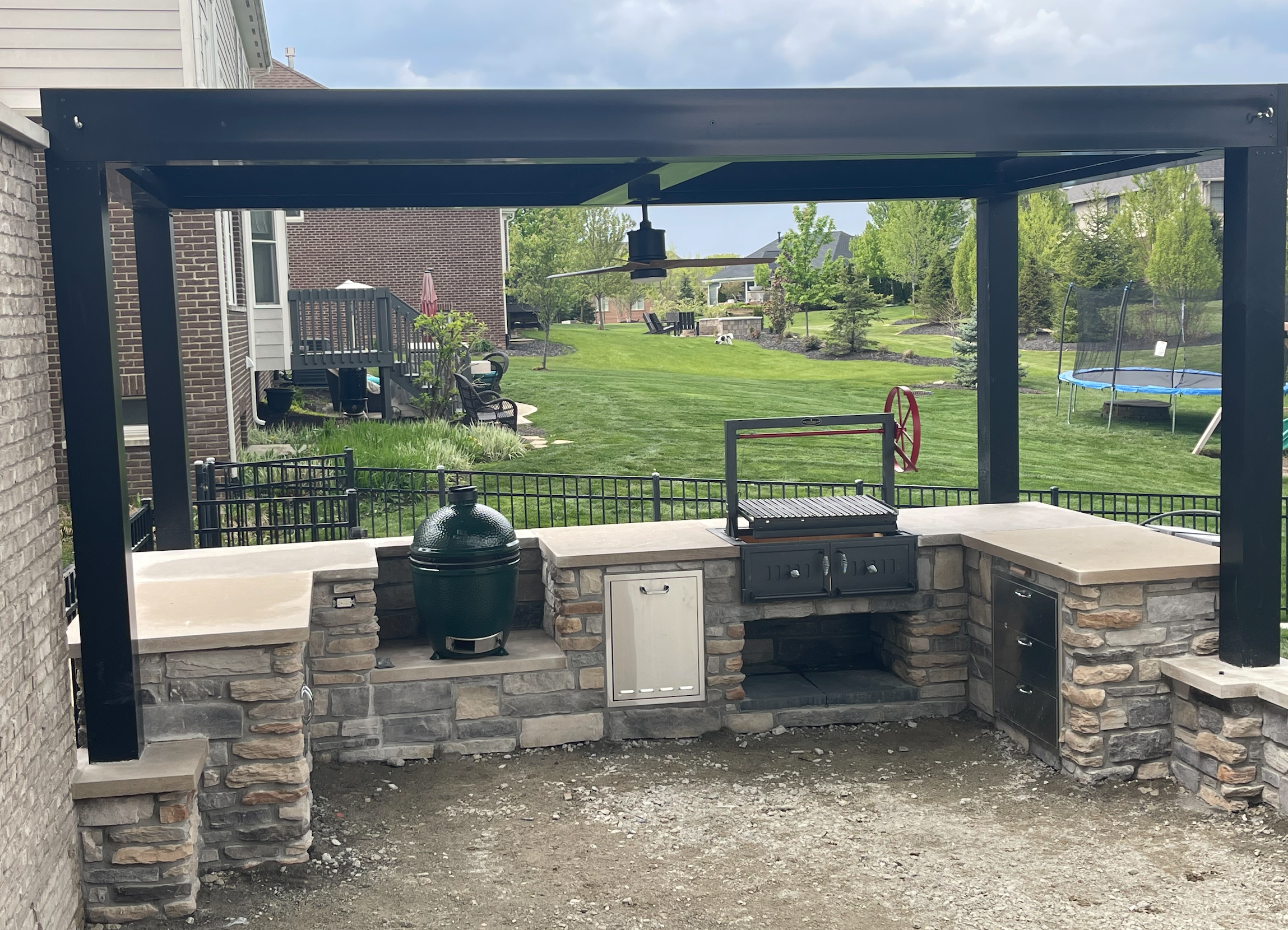
This is the starting point. If you are working with under $5,000, you are looking at a wood or vinyl kit with an open or lattice roof. At $5,000 to $15,000, you can get into a fixed-roof aluminum structure or a smaller louvered system. Above $15,000, you are in the range for a mid-to-large motorized aluminum louvered pergola with accessories. Be honest about your budget, including installation costs if you do not plan to DIY.
2. How Much Space Do You Have?
Measure your available space carefully. A pergola should be large enough to be functional (most people need at least 10x10 for a dining table and chairs) but not so large that it overwhelms your yard. Check setback requirements with your local building department, as most areas require structures to be a certain distance from property lines, fences, and other buildings.
3. What Is Your Climate?
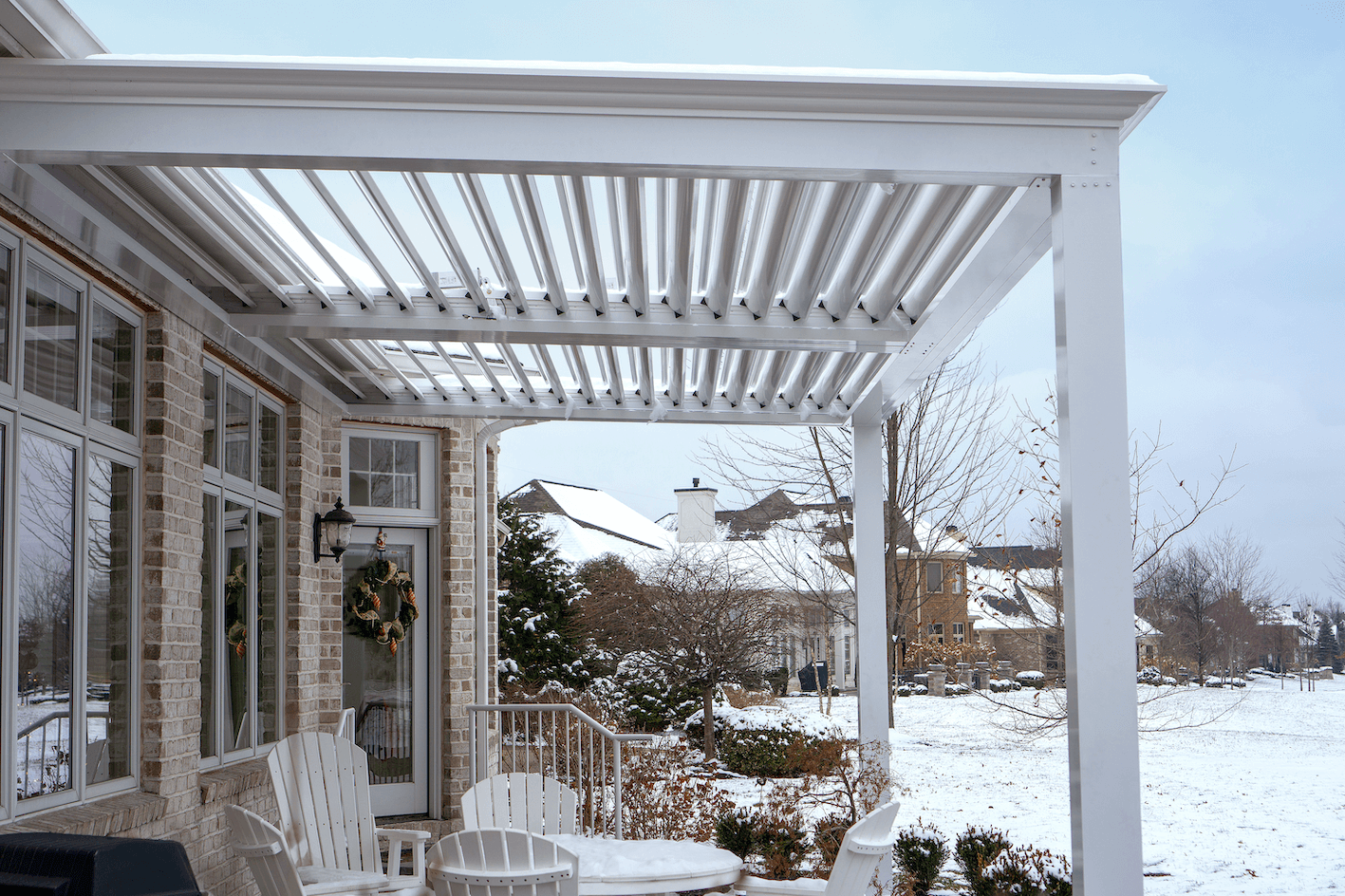
Climate is one of the biggest factors in choosing a pergola type and material. If you live in a region with heavy rain, you need either a louvered or solid-roof pergola that can actually keep water out. If you get snow, you need a structure with a real snow load rating (not just "it probably will be fine"). If you live in a hurricane or high-wind area, look at the wind load rating carefully. A pergola rated for up to 200+ mph wind loads is in a completely different category than one rated for 72 mph.
An open lattice pergola works beautifully in Southern California where it rarely rains. It is not the right choice for Seattle, Miami, or Minnesota.
4. How Will You Use the Space?
Think about what you actually want to do under your pergola:
- Outdoor dining: You want rain protection and shade control. A louvered or solid-roof pergola makes sense.
- Outdoor kitchen: You need full coverage (rain protection is non-negotiable over a grill and countertops).
- Pool shade: A freestanding louvered pergola lets you open up for sunbathing and close for shade on demand.
- Garden accent: An open lattice pergola with climbing vines may be all you need.
- Year-round living space: Go with a motorized louvered system. Nothing else gives you the same flexibility across all four seasons.
5. DIY or Professional Installation?
This is a budget and time decision. A DIY pergola kit will cost much less in installation but does require some time and typically 2-3 sets of hands. If you are comfortable with a few tools and can follow instructions, most pergola kits are very feasible for a weekend project. If you prefer turnkey, add that to the cost or look for manufacturers who have a certified installer network.
So, if you are thinking of a louvered aluminum pergola, take a look at the best pergola kits guide for a breakdown of the options. And if you're ready to start designing your own, you can build your custom pergola using our online configurator.
Frequently Asked Questions
What is a pergola used for?
A pergola is used to create a defined outdoor living space with shade, weather protection, or decorative framing. Common uses include covering a patio dining area, shading a pool deck, protecting an outdoor kitchen, creating a lounge area with furniture and lighting, or simply adding visual structure to a backyard. Modern louvered pergolas also function as rain protection, making outdoor spaces usable in any weather.
What is the difference between a pergola and a gazebo?
A pergola is typically rectangular with an open, louvered, or flat roof, and it can be attached to your house or freestanding. A gazebo is a freestanding, round or multi-sided structure with a fully enclosed peaked roof. Gazebos are usually smaller and serve as a garden focal point, while pergolas are designed to cover a larger functional area like a patio or outdoor kitchen. For a detailed comparison, read our pergola vs gazebo guide.
Do pergolas block rain?
It depends on the type. A traditional open-lattice pergola does not block rain at all. A solid-roof pergola blocks rain completely. A louvered pergola with motorized adjustable louvers blocks rain when the louvers are closed (creating a watertight seal) and allows rain through when the louvers are open. If rain protection is important to you, an open pergola is not the right choice. Look at louvered or solid-roof options with integrated gutter systems that channel water away from the structure.
Are pergolas worth the investment?
For most homeowners, yes. A pergola adds usable outdoor living space, which increases both your enjoyment of your home and its resale value. Real estate studies consistently show that well-designed outdoor living features are among the highest-ROI home improvements. A quality pergola can return 50-80% of its cost at resale while giving you years of daily use. The key is buying a structure that lasts. A cheap pergola that fails in 5 years is not a good investment. A commercial-grade pergola with a lifetime warranty is.
How long do pergolas last?
Lifespan varies dramatically by material. A pressure-treated wood pergola typically lasts 10-15 years with regular maintenance (staining, sealing, replacing rotted boards). Cedar and redwood can last 15-20 years with maintenance. Vinyl pergolas last 15-25 years but can become brittle. Aluminum pergolas are the longest-lasting option, with quality commercial-grade units lasting 30+ years or effectively a lifetime with no structural maintenance required. The Luxury Pergola backs its aluminum structures with a lifetime warranty on the frame, louvers, motor, and electronics.
Do pergolas add value to a home?
Yes. Outdoor living improvements consistently rank among the best returns on investment for home renovation. A professional-looking pergola that creates a functional outdoor room can add $10,000 to $30,000+ to a home's perceived value, depending on the size, quality, and how well it integrates with the overall landscape. The key is quality: a high-end, well-maintained pergola adds value, while a deteriorating wooden structure can actually detract from it.
Can you attach a pergola to your house?
Yes. An attached pergola mounts to your home's exterior wall using a ledger board, similar to how a deck attaches. The other side of the pergola is supported by posts on a concrete pad or deck. Attached pergolas create a natural extension of your indoor living space and are the most common configuration for patio coverage. Just make sure proper flashing and waterproofing are installed where the pergola meets the house, and check your local building codes for permit requirements.
What is the best material for a pergola?
Aluminum is the best overall material for a pergola when you factor in durability, maintenance, lifespan, and versatility. Aluminum does not rot, rust, warp, crack, or need regular staining and sealing. It supports motorized louvered roof systems, integrated gutters, and accessory mounting. The upfront cost is higher than wood or vinyl, but the total cost of ownership over the life of the structure is typically lower because maintenance costs are near zero. Wood (cedar or redwood) is the best choice if you prioritize a traditional natural look and are willing to maintain it regularly.
Do you need a foundation for a pergola?
You need a solid, level surface to anchor the posts. This can be an existing concrete patio, a poured concrete pad, concrete piers dug below the frost line, or a structurally sound deck. You do not necessarily need a full foundation in the traditional sense, but the mounting surface must be able to handle the weight of the structure and the lateral forces from wind. For a freestanding pergola on grass or dirt, you will typically need to pour concrete footings for each post. Your local building code will specify the required footing size and depth.
Can a pergola have a solid roof?
Yes. While the traditional pergola definition involves an open roof, many modern pergolas feature solid roof panels (polycarbonate, insulated metal panels, or glass) that provide full coverage. A louvered pergola takes this a step further: when the motorized louvers are closed, the roof is essentially solid and watertight. When they are open, you get full sunlight and ventilation. This means a motorized pergola gives you both a solid-roof and open-roof experience in one structure.

