


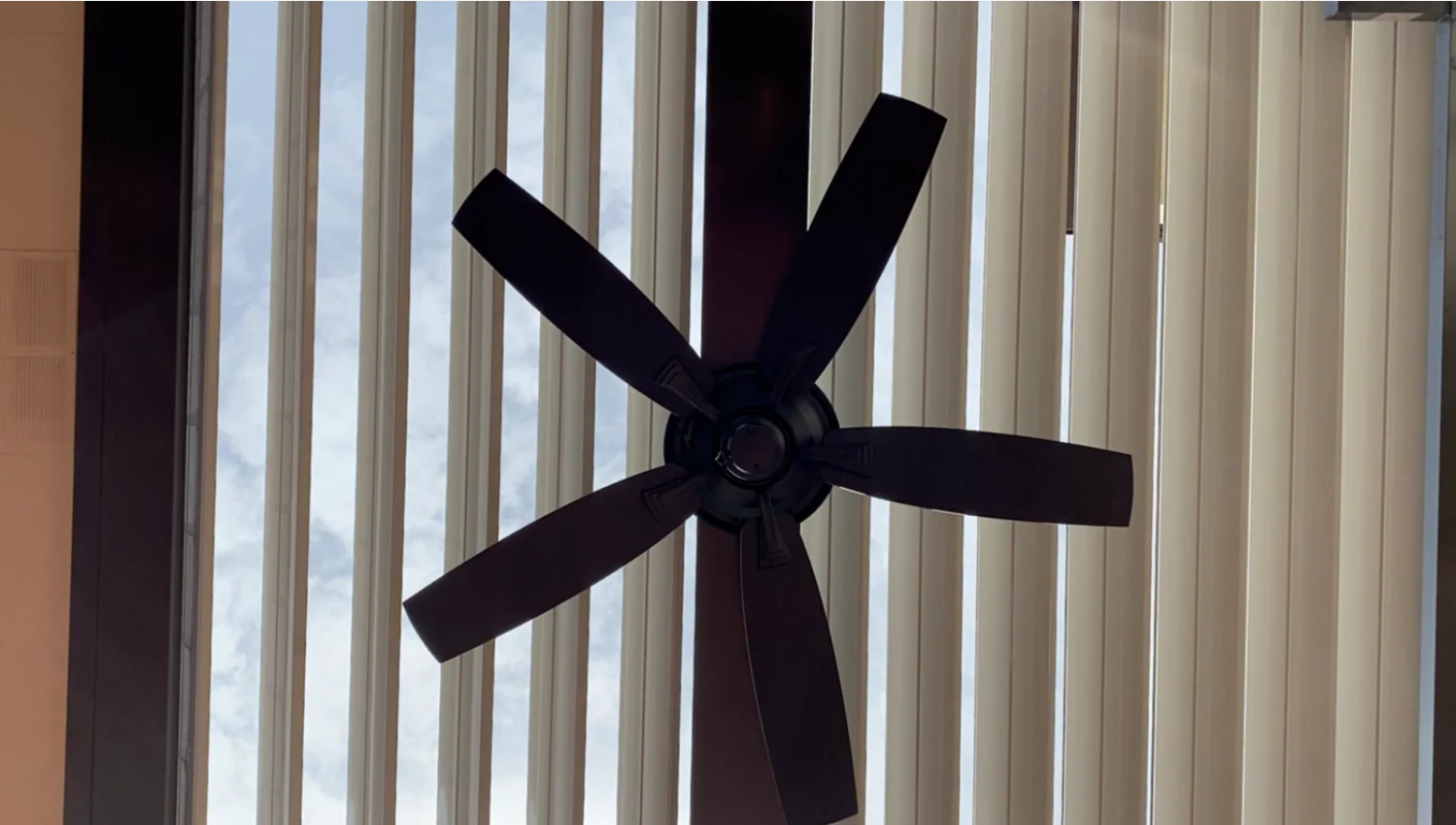
Motorized Pergola: How Automated Roof Systems Actually Work

A motorized pergola uses a built-in electric motor to adjust its roof system with the press of a button. No hand cranks. No manual labor. You press a remote, and the roof moves.
That sounds straightforward, but there is real engineering behind it. The motor, the gear drive, the louver linkage, the rain sensors, the control systems. All of these components work together to give you an outdoor roof that responds to weather in real time. And understanding how they work is the difference between buying a motorized pergola that lasts 25 years and one that stalls out in 3.
This guide breaks down the actual mechanics behind motorized pergola systems, compares the two main types (louvered vs. retractable), gives you real pricing by size and brand, and covers the smart features, installation requirements, and maintenance schedules you need to know before buying.
- What Is a Motorized Pergola?
- How the Motor System Works
- Motorized Louvered vs. Motorized Retractable
- Motorized Pergola Cost by Size and Brand
- Remote Control and Smart Features
- Top Motorized Pergola Brands Compared
- Installation: What to Expect
- Maintenance and Motor Lifespan
- Is a Motorized Pergola Worth It?
- Frequently Asked Questions
What Is a Motorized Pergola?
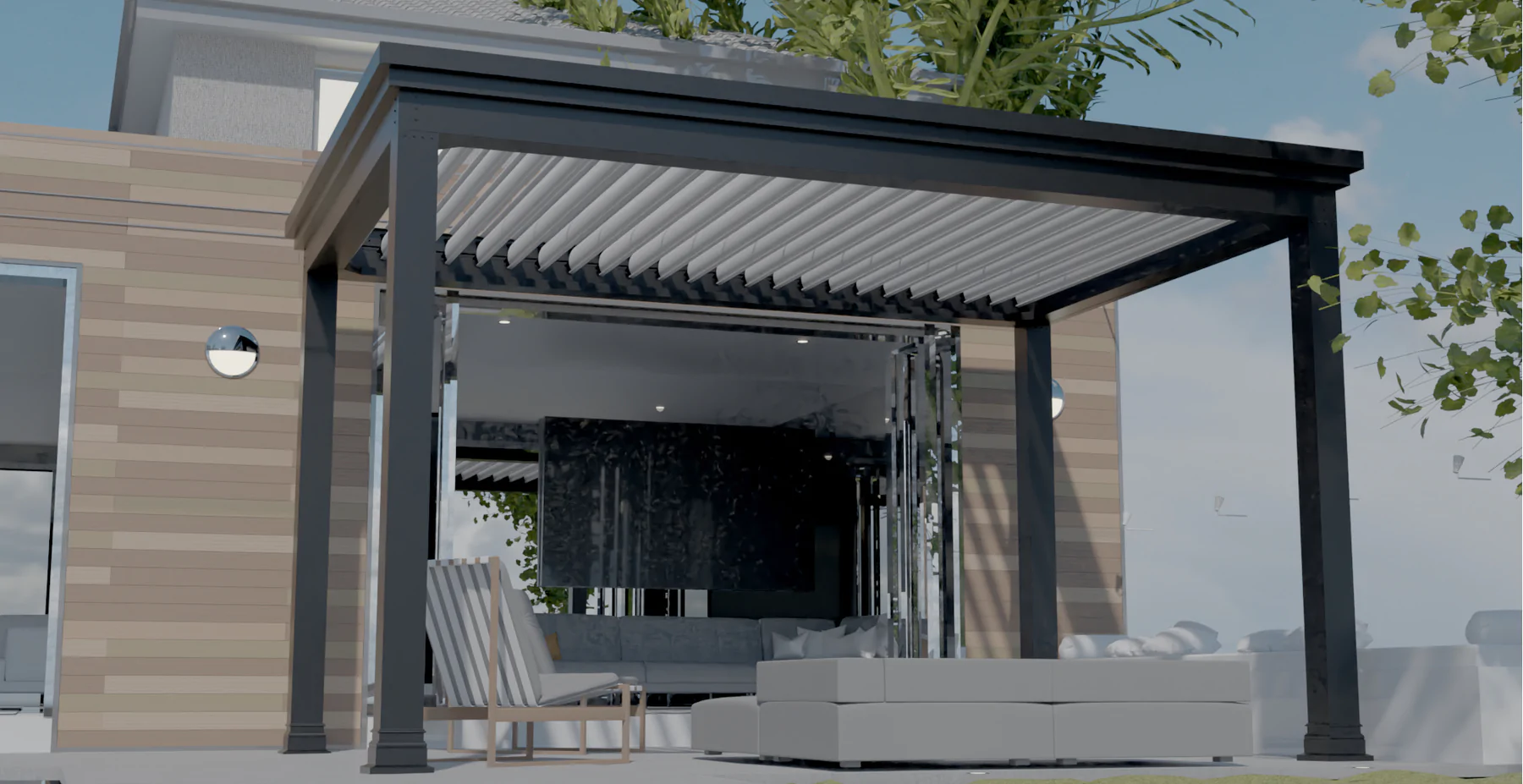
A motorized pergola is an outdoor structure with a roof system powered by an electric motor. Instead of manually adjusting slats, cranking a handle, or pulling fabric across a track, you use a remote control, wall switch, or smartphone app to change the roof position.
The concept has been around in commercial architecture for decades. Restaurants, hotels, and resorts have used motorized roof systems over outdoor dining areas since the early 2000s. What changed in the last ten years is that the technology dropped in price enough for residential use, and direct-to-consumer brands made it possible to buy a commercial-grade motorized pergola without paying a contractor $50,000+ to install it.
There are two main types of motorized pergolas on the market today:
Motorized Louvered Pergola
This is the most common and most functional type. A motorized louvered pergola has a roof made of horizontal aluminum slats (louvers) that rotate on a central axis. When you press the remote, all louvers rotate simultaneously. Open them fully for direct sunlight and maximum airflow. Close them to create a sealed, watertight roof. Or stop them anywhere in between for partial shade.
The best motorized louvered pergola systems rotate the louvers up to 130 degrees, which means you get far more than just "open" and "closed." You get hundreds of shade positions. Learn more about how louvered pergolas work.
Motorized Retractable Pergola
A motorized retractable pergola uses a fabric or shade material that slides along tracks on the pergola frame. The motor extends or retracts the canopy. When extended, you get shade. When retracted, you get open sky.
The trade-off: retractable fabric canopies provide shade but not real rain protection. Water pools on the fabric, and the material sags under any significant rainfall. The fabric also degrades in UV exposure and needs replacement every 5 to 10 years. In high winds, you must retract the canopy or risk damage.
For these reasons, motorized louvered pergolas have become the dominant choice for homeowners who want a permanent, all-weather outdoor structure. The rest of this guide focuses primarily on the motorized louvered type, with comparisons to retractable where relevant.
How the Motor System Works
The motor in a motorized pergola is not what most people picture. It is not a large, noisy industrial motor bolted to the frame. It is a small, quiet electric motor concealed inside the pergola's main beam. Most homeowners never see it, and guests do not know it exists until the roof starts moving.
Here is how the complete motor system works, step by step:
The Motor Unit
Most motorized pergola systems use a 24V DC motor. This is a low-voltage motor, similar to what you would find in a high-end motorized window shade. It draws minimal power, runs quietly, and generates enough torque to rotate dozens of heavy aluminum louvers simultaneously.
The motor is typically mounted inside the pergola's header beam (the beam that runs along the top of the structure, parallel to the louvers). This keeps it completely hidden from view and protected from weather.
The Gear Drive and Linkage
The motor connects to a gear drive that translates the motor's rotation into the linear push-pull motion needed to rotate the louvers. A drive rod runs the length of the header beam, connecting to each louver through individual linkage arms.
When the motor turns, the drive rod moves. The linkage arms pivot, and all louvers rotate in unison. The engineering here matters. A well-designed linkage system distributes force evenly across every louver, so the first louver and the last louver move at the same speed, to the same angle, at the same time. Poorly designed systems bind, wobble, or develop uneven gaps over time.
Rotation Speed and Range
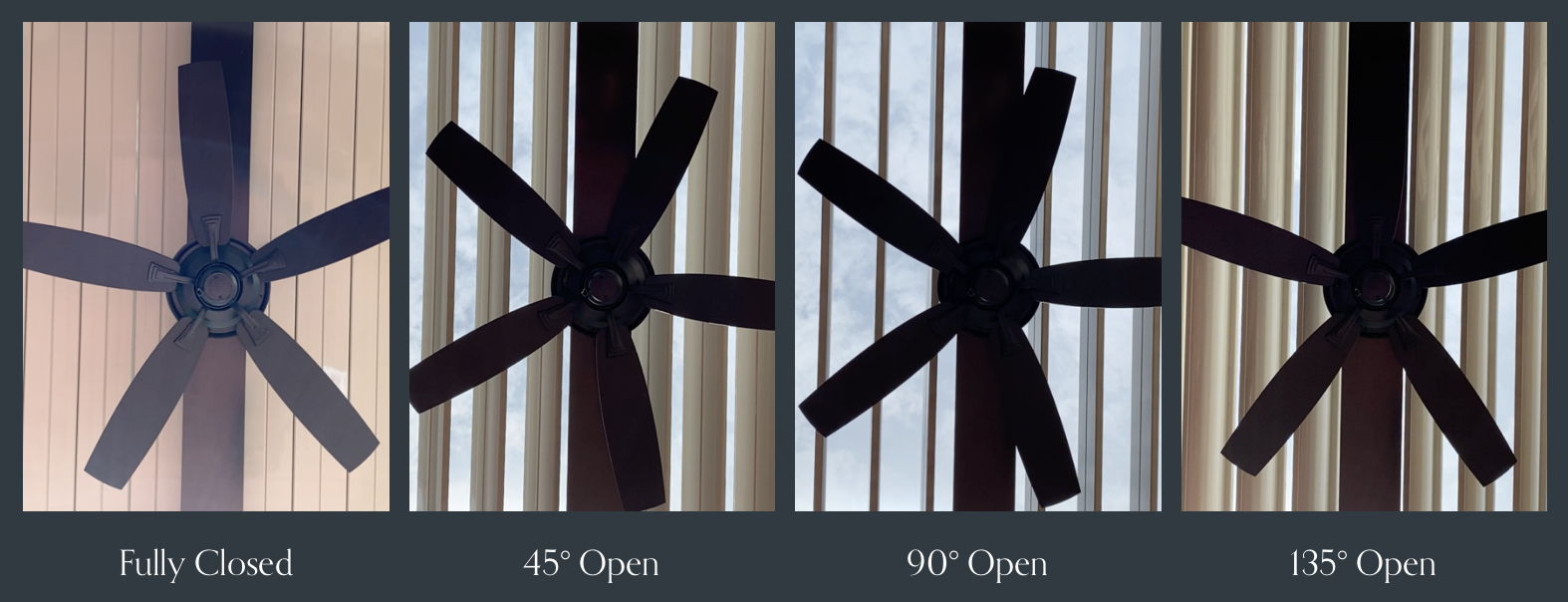
A quality motorized pergola completes a full open-to-close cycle in about 10 to 15 seconds. The Luxury Pergola's system provides up to 130 degrees of rotation, which is significant. Some budget systems only rotate 90 degrees (flat to vertical), which limits your shade control. That extra 40 degrees of rotation means the louvers can actually angle past vertical, directing light and airflow with far more precision.
You can stop the louvers at any point during rotation. This is not an "open or closed" system. You have infinite positioning between fully open and fully closed.
The Seal
When louvers close, the edges overlap or interlock to form a seal. On commercial-grade motorized pergola kits, this seal creates a watertight roof that channels rainwater into integrated gutters built into the frame beams. The water drains down through the hollow posts and exits at ground level. You never see the drainage system. It is entirely concealed inside the structure.
This integrated gutter system is what separates a true motorized louvered pergola from cheaper alternatives where water simply drips off the louver edges.
What Makes TLP's System Different
The Luxury Pergola's motor system is built into a structure that weighs 1,800 lbs at the 10x13 size. For comparison, imported motorized pergola kits in the same size typically weigh 250 to 450 lbs. That weight difference is not just in the frame. It is thicker louvers, larger drive components, and heavier-gauge linkage arms that do not flex or fatigue over thousands of cycles.
The motor itself is backed by a lifetime warranty, which is unusual. Most competitors warrant their motors for 2 to 5 years. A lifetime motor warranty tells you how confident the manufacturer is in the drive system's durability. Compare motorized louvered pergola kits.
Motorized Louvered vs. Motorized Retractable
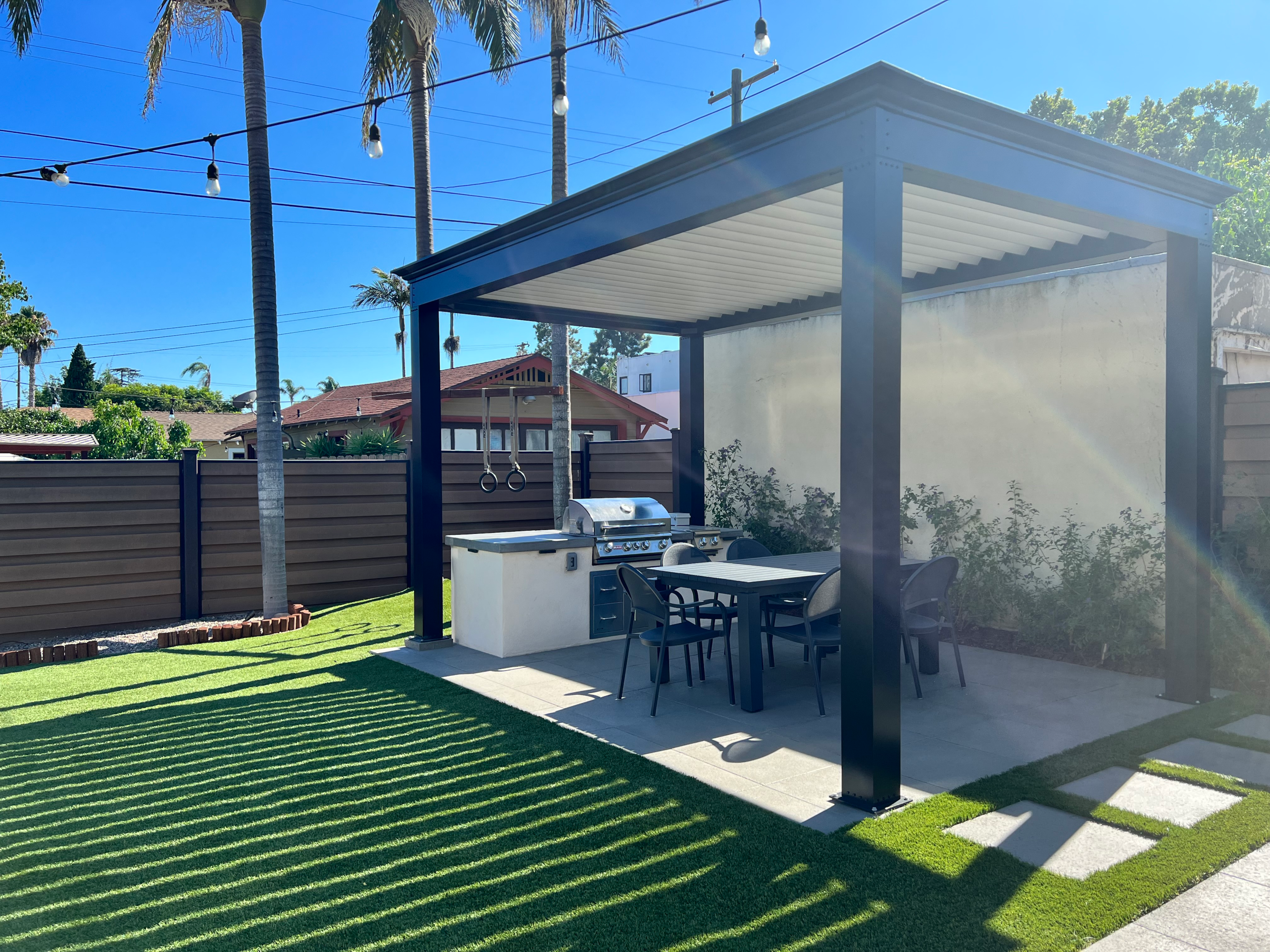
Both systems are motorized. Both give you push-button control over your outdoor shade. But the similarities end there. Here is a direct comparison:
| Feature | Motorized Louvered | Motorized Retractable |
|---|---|---|
| Roof material | Aluminum louvers (solid metal) | Fabric canopy (polyester, acrylic, or PVC) |
| Rain protection | Full waterproof seal with integrated drainage | Limited. Fabric sags and pools water in moderate rain |
| Snow load capacity | Up to 65 psf (commercial-grade models) | 0 psf. Must retract before any snow accumulation |
| Wind rating | Up to 200+ mph (closed, commercial-grade) | Must retract at 25-35 mph or risk tearing |
| Shade control | Infinite positions between fully open and fully closed | Extended or retracted. No partial shade positions |
| Motor lifespan | 10,000-50,000+ cycles (13-68+ years at 2 cycles/day) | 5,000-15,000 cycles |
| Roof replacement | Never. Aluminum does not degrade | Every 5-10 years. UV breaks down fabric |
| Cost range (10x13) | $5,000-$22,000 (DTC), $35,000-$60,000 (installed) | $3,000-$12,000 |
| Maintenance | Rinse with hose 2-3x/year | Fabric cleaning, mildew treatment, replacement |
| Lifespan | 25+ years | 8-15 years (structure), 5-10 years (fabric) |
The retractable option makes sense in one scenario: you want a shade canopy for a temporary space, you live in a mild climate with little rain, and you want the lowest upfront cost.
For everything else, a motorized louvered pergola is the better investment. It handles rain, snow, wind, and sun. It does not require fabric replacement. And the aluminum roof will look the same in 20 years as it does the day you install it, provided you buy a unit with a quality powder coat finish. Read our guide to pergolas with roof systems.
Motorized Pergola Cost by Size and Brand

Motorized pergola pricing varies wildly depending on the brand, build quality, and whether you are buying factory-direct or through a dealer/installer. Here is what real pricing looks like across the market:
Motorized Pergola Kit Pricing by Brand (10x13 Size, DTC)
| Brand | Price Range | Weight | Wind Rating | Warranty | Made in USA? |
|---|---|---|---|---|---|
| The Luxury Pergola | $12,000-$22,000 | ~1,800 lbs | Up to 200+ mph | Lifetime | Yes (Indiana) |
| BON Pergola | $5,000-$9,000 | ~400-600 lbs | Up to 110 mph | 5-10 years | No |
| PERGOLUX | $4,500-$8,500 | ~350-500 lbs | Up to 75 mph | 5 years | No |
| Purple Leaf / Budget DTC | $2,000-$5,000 | ~250-400 lbs | 55-80 mph | 3-5 years | No |
Motorized Pergola Pricing by Brand (Dealer-Installed)
| Brand | Price Range (10x13, Installed) | Wind Rating | Warranty |
|---|---|---|---|
| StruXure | $35,000-$55,000 | Up to 130 mph | 10 years (frame) |
| Azenco | $40,000-$60,000+ | Up to 135 mph | 10 years |
How Size Affects Motorized Pergola Cost
| Size | Budget Tier (Import) | Mid-Range DTC | Commercial-Grade DTC (TLP) | Dealer-Installed |
|---|---|---|---|---|
| 10x10 | $2,000-$4,000 | $5,000-$9,000 | $10,000-$16,000 | $30,000-$45,000 |
| 10x13 | $2,500-$5,000 | $6,000-$12,000 | $12,000-$22,000 | $35,000-$55,000 |
| 12x16 | $4,000-$7,000 | $8,000-$15,000 | $16,000-$28,000 | $45,000-$70,000 |
| 12x20 | $5,000-$9,000 | $10,000-$18,000 | $20,000-$35,000 | $55,000-$85,000 |
Additional Costs to Budget For
- Concrete footings or pad: $200 to $800
- Electrical circuit (110V dedicated line): $200 to $600
- Building permits: $0 to $500 depending on your municipality
- Professional installation (if not DIY): $2,000 to $5,000
- Smart control upgrades (rain/wind sensors, smart home bridge): $200 to $600
The critical takeaway: a commercial-grade motorized pergola purchased factory-direct costs roughly the same as what you would pay a dealer just for the installation labor on a StruXure or Azenco system. You get the same or better materials, a better warranty, and you keep $15,000 to $30,000 in your pocket. See our full motorized pergola cost breakdown.
Remote Control and Smart Features

The motor is only half the equation. The control system determines how you interact with your motorized pergola every day.
RF Remote Control
Every motorized pergola ships with a handheld RF (radio frequency) remote. This is the primary control method for most homeowners. The remote communicates wirelessly with the motor's receiver, so there is no line-of-sight requirement. It works through walls, from inside the house, or from across the yard.
Range varies by manufacturer, but most RF remotes work reliably within 50 to 100 feet. You press and hold a button to rotate the louvers open, press another to close, and release to stop at any position.
Wall Switch
A hardwired wall switch mounts near your back door or on the pergola post itself. It provides a permanent control point that cannot be lost or misplaced like a remote. Wall switches are especially useful for families, since everyone who walks outside can adjust the roof without hunting for a remote.
Rain Sensors
This is where a motorized pergola becomes genuinely intelligent. A rain sensor mounts on top of the pergola frame and detects moisture. When rain starts, the sensor sends a signal to the motor, and the louvers close automatically. No human input required.
This matters more than most people realize. You leave for work with the louvers open. An afternoon thunderstorm rolls through. Without a rain sensor, your outdoor furniture, grill, and patio get soaked. With a rain sensor, the roof closes itself within seconds of the first drops hitting the sensor.
The Luxury Pergola offers the Breeze Pro sensor, which monitors rain, wind, and sun conditions. It auto-closes the louvers when rain or high wind is detected, and can auto-adjust louver angle based on sun intensity. This level of automation turns your motorized pergola into a fully responsive outdoor environment.
Wind Sensors
Wind sensors work on the same principle as rain sensors. When sustained wind speeds exceed a preset threshold, the sensor triggers the motor to move the louvers to their safest position (typically closed and locked, or open to allow wind to pass through, depending on the system design and wind direction).
On commercial-grade structures rated for up to 200+ mph wind loads, the wind sensor is less about structural protection and more about comfort. It closes the louvers when gusty conditions would otherwise blow debris or rain sideways under the roof.
Smart Home Integration

The newest generation of motorized pergola controls includes smart home connectivity. The Bond Bridge Pro connects your pergola's motor to Wi-Fi, enabling:
- Smartphone app control: Open, close, or adjust louvers from your phone, anywhere you have internet access
- Voice control: "Alexa, close the pergola" or "Hey Google, open the pergola to 50%"
- Scheduling: Set the louvers to open every morning at 7 AM and close at sunset
- Scene integration: Include your pergola in smart home scenes. "Movie night" closes the louvers, dims the patio lights, and turns on the outdoor speakers
Smart home integration is still an add-on for most motorized pergola brands, not a built-in feature. But the technology is mature and the setup takes minutes, not hours. If you already have Alexa, Google Home, or Apple HomeKit in your house, connecting your pergola to the same ecosystem is straightforward. Read our smart pergola guide.
Top Motorized Pergola Brands Compared

Not all motorized pergolas are created equal. Here is a side-by-side comparison of the major brands in the motorized pergola market:
| Brand | Motor Type | Control Options | Wind Rating | Warranty | Price Range (10x13) | Made in USA? |
|---|---|---|---|---|---|---|
| The Luxury Pergola | 24V DC, concealed in beam | RF remote, wall switch, rain/wind/sun sensor, Bond Bridge smart home | Up to 200+ mph | Lifetime (frame, louvers, motor, electronics, finish) | $12,000-$22,000 | Yes |
| StruXure | 24V DC, concealed | Remote, app, rain sensor | Up to 130 mph | 10 years (frame only) | $35,000-$55,000 (installed) | Yes |
| Azenco | 24V DC, concealed | Remote, app, sensors | Up to 135 mph | 10 years | $40,000-$60,000+ (installed) | No (France) |
| BON Pergola | 24V DC motor | RF remote, wall switch | Up to 110 mph | 5-10 years | $5,000-$9,000 | No |
| PERGOLUX | Standard motor | RF remote | Up to 75 mph | 5 years | $4,500-$8,500 | No |
| Purple Leaf / Budget DTC | Basic DC motor | RF remote | 55-80 mph | 3-5 years | $2,000-$5,000 | No |
What the Table Tells You
The motorized pergola market has clear tiers. Budget imports offer a low entry point but sacrifice wind ratings, structural weight, and warranty length. Dealer-installed brands (StruXure, Azenco) offer quality materials but add $20,000 to $40,000 in dealer/installer markup.
The Luxury Pergola sits in a unique position: commercial-grade engineering (1,800 lbs, up to 200+ mph wind, up to 65 psf snow, lifetime warranty on everything) at factory-direct pricing. The motor, the electronics, the frame, and the ElectroLayer powder coat finish are all covered for life. No other brand in this comparison offers that.
Read what customers say: "The structural integrity is hands down superior to competition." That weight difference is something you can feel the moment you touch the frame. See our full aluminum pergola brand comparison.
Installation: What to Expect
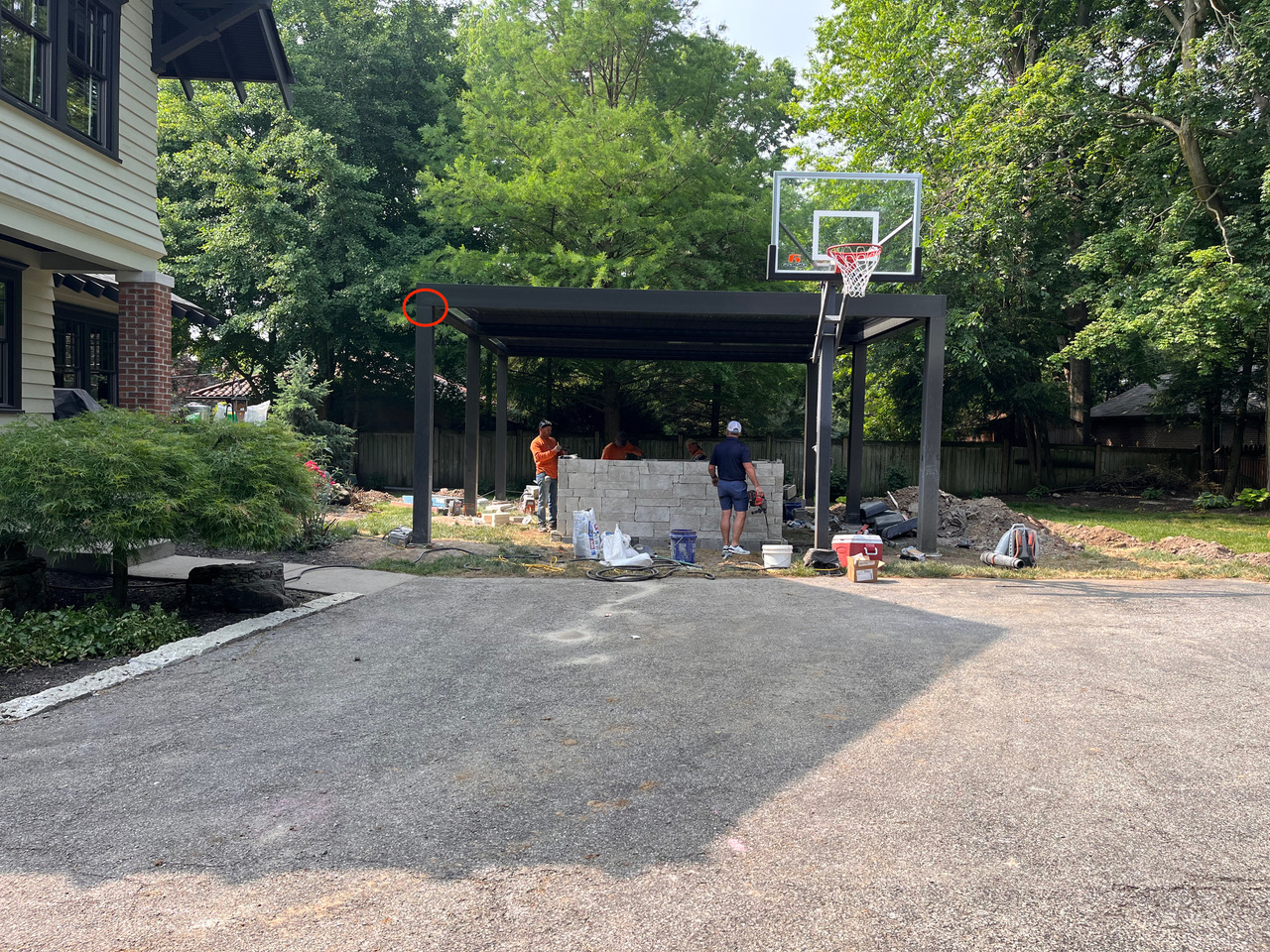
Installing a motorized pergola is more accessible than most people expect. The motor adds almost no complexity to the installation process itself, since it arrives pre-installed inside the beam. The installation is really about assembling the structure. The motor and wiring are already done.
Electrical Requirements
A motorized pergola needs electricity to operate the motor. Here are your options:
- Standard 110V outlet: The simplest approach. If you already have an outdoor GFCI outlet within reach of the pergola, you can plug in directly. The motor draws very little power (comparable to a laptop charger)
- Dedicated circuit: For a cleaner installation with no visible cords, an electrician runs a dedicated 110V line from your breaker panel to the pergola location. Cost: $200 to $600 depending on distance. This is the recommended approach for permanent installations
- Hardwired connection: Some homeowners hardwire the power directly into the pergola post, with the wire running underground from the house. This is the cleanest look but requires an electrician
The key point: you do not need a high-voltage commercial electrical setup. A motorized pergola runs on standard household current. An electrician can do the wiring in 1 to 2 hours.
Installation Timeline
For a factory-direct motorized pergola kit that ships pre-cut, pre-drilled, and pre-labeled:
- People needed: 2 to 3 adults
- Time: 6 to 10 hours (one full day)
- Tools: Socket set, drill/driver, level, ladder, tape measure
- Foundation: Existing concrete pad or poured footings (must be in place before assembly day)
The assembly is mechanical, not technical. You are bolting pre-made aluminum components together in a specific sequence. The motor, wiring, and control receiver are pre-installed in the beam at the factory. You connect the power cable and the system is operational.
DIY vs. Professional Installation
The decision comes down to comfort level, not complexity:
DIY makes sense when: You are comfortable with basic tools, you have 2 to 3 helpers, and you want to save $2,000 to $5,000 in installation costs. Most motorized pergola kit manufacturers provide video walkthroughs, step-by-step manuals, and phone support during installation.
Professional installation makes sense when: You would rather not handle heavy components (beams on commercial-grade kits weigh 50 to 100+ lbs each), you need electrical work done at the same time, or you simply prefer someone else to do it. Many motorized pergola brands now have certified installer networks. The Luxury Pergola is actively expanding a national network of certified installers for customers who want turnkey service.
When You Need an Electrician
You need a licensed electrician if:
- You do not have an existing outdoor outlet near the pergola location
- You want the power connection hidden (underground conduit to the pergola post)
- Your local building code requires permitted electrical work for outdoor structures
- You are adding accessories that need power (fans, lights, heaters) and want everything on one circuit
Budget $200 to $600 for electrician work, scheduled either before or on the same day as your pergola installation. See our full DIY installation guide with video.
Maintenance and Motor Lifespan

One of the biggest advantages of a motorized pergola over other outdoor structures is how little maintenance it requires. There is no wood to stain, no fabric to clean and retreat, no rust to sand and repaint. But "low maintenance" does not mean "zero maintenance." Here is what you need to know.
How Long Do Pergola Motors Last?
Quality motors are rated for 10,000 to 50,000+ open/close cycles. At an average of 2 cycles per day (opening in the morning, closing at night), that translates to:
- 10,000 cycles: ~13.7 years
- 25,000 cycles: ~34 years
- 50,000 cycles: ~68 years
Even at the low end, a quality motor will outlast most homeowners' tenure in the house. And the motor is a replaceable component. If a motor fails after 15 years, you replace the motor, not the pergola. Cost for a motor replacement is typically $300 to $800 depending on the brand.
Budget motors found in imported kits tend to be at the lower end of the cycle range with less robust internal components. This is where warranty matters. A 3-year motor warranty tells you the manufacturer expects the motor to potentially fail after 3 years. A lifetime motor warranty tells you something very different.
What Can Go Wrong
- Motor failure: Rare on quality units. Usually caused by water intrusion (poor frame sealing), power surges (install a surge protector), or cycle fatigue (thousands of extra cycles from children playing with the remote)
- Linkage binding: On poorly designed systems, the linkage arms can bind or develop play over time, causing louvers to rotate unevenly. This is a design and engineering issue, not a maintenance issue
- Control board failure: The electronic receiver board can fail, especially in extreme heat environments. Quality boards are potted (sealed in resin) to resist moisture and heat
- Remote/sensor failure: Battery-powered remotes need battery replacement. Sensors need occasional cleaning. These are minor items
Annual Maintenance Checklist
- Rinse the frame and louvers with a garden hose 2 to 3 times per year. This removes pollen, dust, and bird droppings that can accumulate
- Clear the gutters and downspouts before heavy rain season. Leaves and debris can block the integrated drainage channels
- Check the louver seal by closing the louvers and running a hose over the top. Water should drain cleanly through the gutters, not drip between louvers. If it drips, inspect the seal gaskets
- Test the rain sensor by pouring a small amount of water on it. The louvers should begin closing within seconds
- Inspect the powder coat finish for any scratches or chips. Touch up if needed (though quality coatings like ElectroLayer rarely need this)
Total annual maintenance time: about 30 minutes, two to three times a year. Compare that to a wood pergola that needs sanding and re-staining every 1 to 2 years (a full weekend project), and you understand why aluminum motorized pergolas have taken over the market.
The Lifetime Warranty Advantage
The Luxury Pergola offers a lifetime warranty on the frame, louvers, motor, electronics, and ElectroLayer finish. This is the most comprehensive warranty in the motorized pergola industry. If anything fails due to manufacturing or material defect, it is covered. For life. Not 5 years. Not 10 years. For as long as you own the structure.
That warranty is possible because of the engineering underneath it. When a structure weighs 1,800 lbs, uses commercial-grade aluminum extrusions, and goes through a multi-stage powder coat process, the failure rate drops to near zero. The warranty is not a marketing promise. It is a reflection of the build quality.
Is a Motorized Pergola Worth It?

A motorized pergola is a significant investment. Even at the factory-direct price point, you are looking at $10,000 to $25,000 for a quality unit. So is it worth it?
Home Value Impact
Outdoor living improvements consistently rank among the highest-ROI home upgrades. According to the National Association of Realtors, outdoor living spaces return 60% to 80% of their cost at resale. A well-built motorized pergola falls at the high end of that range because it is a permanent, engineered structure, not a temporary addition.
Real estate agents report that homes with covered outdoor living spaces sell faster and command higher prices, particularly in warm-climate markets (Florida, California, Texas, Arizona). A motorized louvered pergola is one of the few outdoor upgrades that is both visually impressive and functionally practical, which is exactly what buyers want.
Usability Gain
Without a covered outdoor space, most patios are usable only on days with mild weather, no rain, and tolerable sun. That is roughly 100 to 150 days per year in most of the US.
A motorized pergola extends your outdoor season to nearly year-round:
- Rain: Close the louvers. You are dry
- Intense sun: Adjust louvers for partial shade. Up to 20 degrees cooler under closed louvers
- Light snow: Close louvers. The roof handles up to 65 psf of snow load on commercial-grade units
- Wind: The structure is rated for up to 200+ mph on commercial-grade units. Your patio furniture is more likely to move than the pergola
That 100-day patio becomes a 300+ day outdoor room. Over a 25-year lifespan, you are adding roughly 5,000 extra days of outdoor living. At a $15,000 investment, that is $3 per extra day of use.
Motorized vs. Manual: When Each Makes Sense
Motorized is worth it when:
- You plan to use the pergola daily and want instant adjustment
- You want rain sensor automation (the biggest practical advantage of motorized)
- The pergola covers an outdoor kitchen, dining area, or living space where you entertain
- You want smart home integration
- You value convenience and will actually use all the shade positions
Manual or fixed roof is fine when:
- The pergola is primarily decorative (garden trellis, vine support)
- You rarely need to adjust the louver position
- Budget is the primary constraint and the $500-$1,500 motor savings matters
For most homeowners investing $10,000+ in an outdoor structure, the motor upgrade is one of the smallest line items with one of the largest impacts on daily usability. It is almost always worth it.
The Real ROI Calculation
Consider this: a professionally installed StruXure or Azenco motorized pergola costs $40,000 to $60,000. A factory-direct motorized pergola from The Luxury Pergola with equal or better specs costs $12,000 to $22,000. The $20,000 to $40,000 you save buys a lot of outdoor furniture, a built-in grill, or simply stays in your pocket.
That is the real value proposition of the modern motorized pergola kit: commercial-grade engineering, factory-direct pricing, and a structure you can install yourself in a day. Configure your motorized pergola.
Frequently Asked Questions
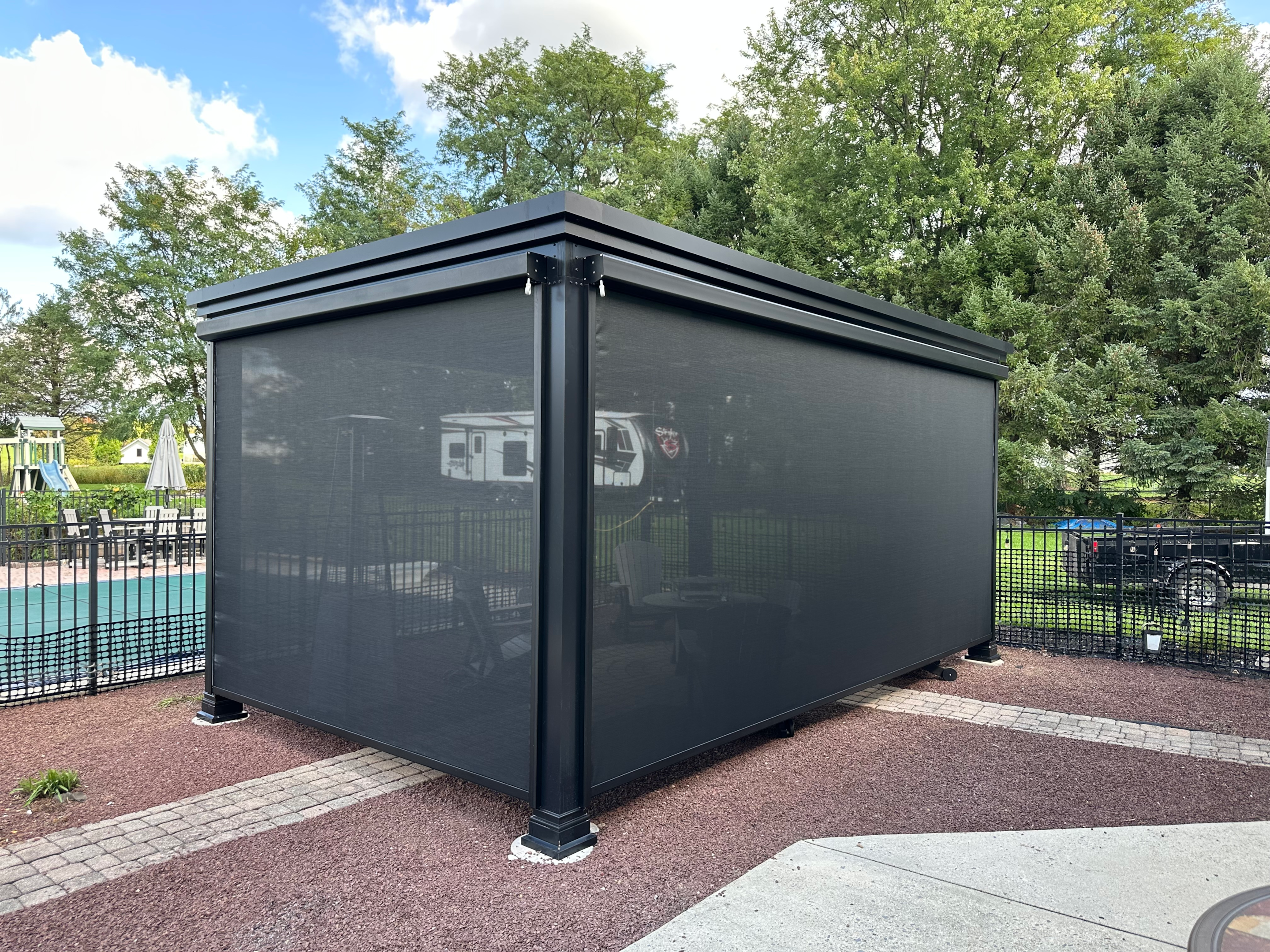
How much does a motorized pergola cost?
A motorized pergola costs anywhere from $2,000 for a lightweight imported kit to $60,000+ for a professionally installed system. Factory-direct commercial-grade motorized pergola kits from brands like The Luxury Pergola range from $12,000 to $22,000 for a standard 10x13 size. This includes the motor, remote control, and integrated rain gutter system. Additional costs include concrete footings ($200-$800), electrical work ($200-$600), and optional rain/wind sensors ($200-$600). See our full cost breakdown.
How long does a motorized pergola motor last?
Quality motorized pergola motors are rated for 10,000 to 50,000+ open/close cycles. At a typical usage rate of 2 cycles per day, that is 13 to 68+ years of daily use. The motor is also a replaceable component, so if it does eventually wear out, you replace the motor unit ($300-$800) rather than the entire pergola. The Luxury Pergola backs its motor with a lifetime warranty.
Can a motorized pergola close automatically when it rains?
Yes, with a rain sensor installed. A rain sensor mounts on top of the pergola frame and detects moisture. When rain is detected, it sends a signal to the motor and the louvers close automatically within seconds. This feature works even when you are not home. The Breeze Pro sensor available for The Luxury Pergola monitors rain, wind, and sun, providing fully automated climate response.
Do motorized pergolas work during a power outage?
Most motorized pergolas require electricity to operate. During a power outage, the louvers stay in whatever position they were in when power was lost. Some manufacturers offer a manual override mechanism (hand crank or hex key) that allows you to manually adjust louvers during an outage. If you live in an area with frequent power outages, ask about backup operation before purchasing.
Can I install a motorized pergola myself?
Yes. Most motorized pergola kits ship pre-cut, pre-drilled, and pre-labeled for homeowner assembly. The motor arrives pre-installed inside the beam, so you are not wiring a motor yourself. You need 2 to 3 adults, basic tools (socket set, drill, level, ladder), and about 6 to 10 hours. The main challenge on commercial-grade kits is weight, not complexity. Individual beams can weigh 50 to 100+ lbs. See our DIY installation guide.
What is the difference between a motorized pergola and an electric pergola?
They are the same thing. "Motorized pergola" and "electric pergola" are interchangeable terms that both describe a pergola with an electrically powered motor controlling the roof system. Some people also search for "automated pergola" or "remote control pergola." All of these refer to the same product category: a pergola with a motor-driven adjustable roof.
Do I need an electrician to install a motorized pergola?
You need an electrician only if you do not have an existing outdoor outlet near the installation location and want to run a dedicated electrical circuit. The pergola motor plugs into a standard 110V outlet. If you already have a GFCI outdoor outlet within cord reach, no electrician is needed. For a cleaner installation with hidden wiring (underground conduit to the pergola post), budget $200 to $600 for electrical work.
Is a motorized louvered pergola better than a motorized retractable pergola?
For most applications, yes. A motorized louvered pergola provides full rain protection (sealed aluminum roof with integrated gutters), handles snow loads (up to 65 psf on commercial-grade units), resists high winds (up to 200+ mph), and never needs roof replacement. A motorized retractable pergola uses fabric that sags in rain, cannot handle any snow, must retract in wind above 25-35 mph, and needs fabric replacement every 5-10 years. The retractable type costs less upfront, but the louvered type costs less over a 20-year span due to zero roof replacement costs.

