

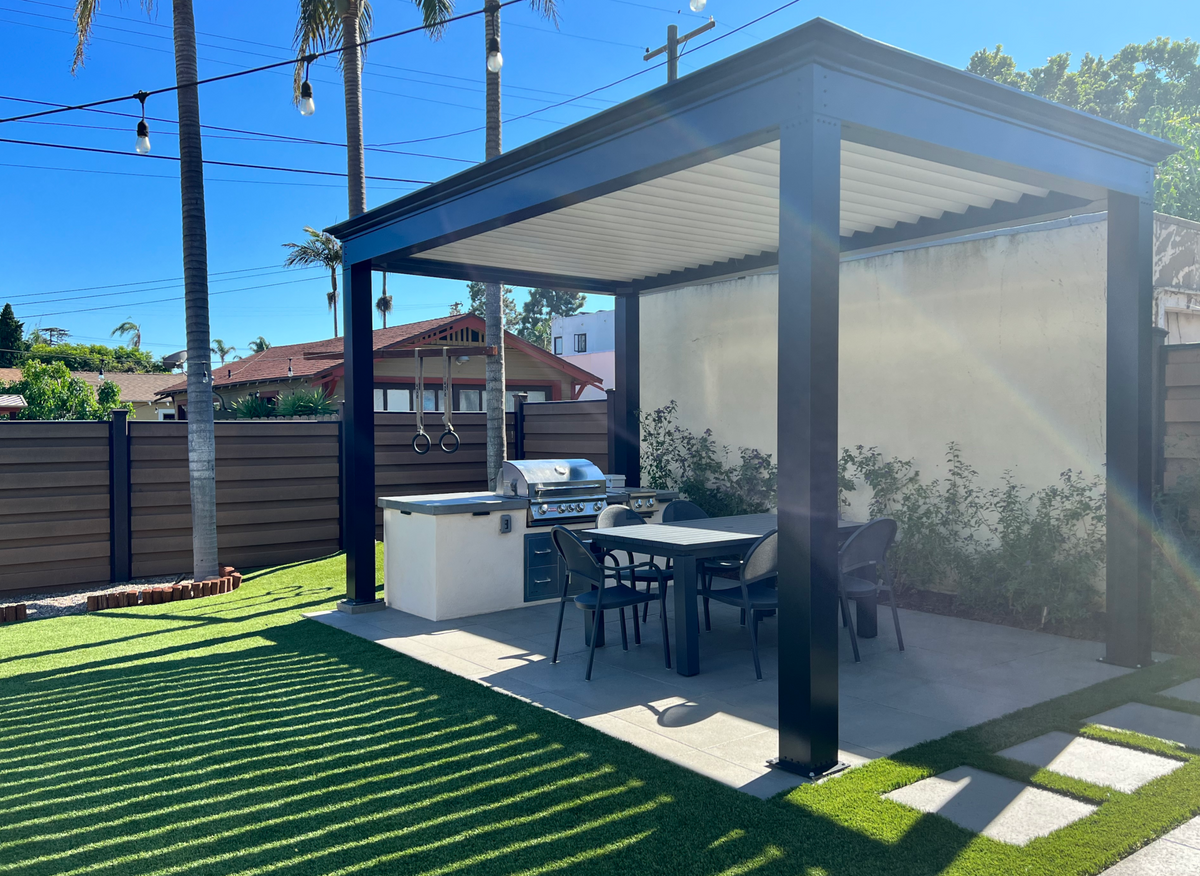
"Pergolas that open and close" is the most common way people search for what the industry calls a louvered pergola. It is a pergola with a roof made of adjustable aluminum slats (louvers) that rotate from fully open to fully closed in seconds, giving you on-demand control over sunlight, shade, airflow, and rain protection.
If you have been searching for a pergola with a roof that opens and closes, this guide explains exactly how they work, what types exist, which design is best for different situations, and what specs actually matter when comparing brands. No filler. Just the information you need to make a smart buying decision.
What this guide covers:
- What is a pergola that opens and closes?
- How louvered pergolas work (motor, controls, drainage, rain sensors)
- Types of adjustable roof pergolas
- Why motorized louvered is the best "open and close" option
- Comparison table: motorized louvered vs. manual vs. retractable vs. sliding
- What to look for when buying
- Brand comparison: TLP vs. StruXure vs. BON vs. Costco Mirador For a direct comparison, compare The Luxury Pergola and StruXure side by side. You can also read our The Luxury Pergola vs Hansø comparison.
- Cost overview
- FAQ

What Is a Pergola That Opens and Closes?
A pergola that opens and closes is an outdoor structure with a roof system that transitions between open-air and fully covered. When the roof is open, you get unobstructed sunlight and sky. When it is closed, you get a solid, watertight overhead cover that blocks rain, snow, and harsh sun.
The most common and most capable version of this concept is the motorized louvered pergola. Instead of a single panel that slides or a fabric canopy that retracts, a louvered pergola uses parallel aluminum slats that rotate on an axis. This gives you something no other design offers: infinite positions between fully open and fully closed.
That means you are not just choosing between "sun" and "shade." You can angle the louvers to let in morning light while blocking the afternoon glare. You can crack them open for airflow while still keeping rain out. You can close them completely to create a sealed roof that channels water through integrated gutters and away from your patio.
The term "pergola that opens and closes" covers several different product types. But if you want precision control, weather protection, and a structure that lasts decades, motorized louvers are the answer. The rest of this guide explains why.
How Louvered Pergolas Work
Understanding the mechanics helps you evaluate quality differences between brands. Here is what is happening inside a louvered pergola when you press the button.
Motor-Driven Louver Rotation
Each louver (the individual aluminum slat) is mounted on a central rod that runs along its length. A motor, typically 24V DC for safety, connects to this rod system and rotates all louvers simultaneously. When you press the remote, the motor turns and every louver in the roof moves together in perfect sync.
The rotation range determines how much control you have. On commercial-grade systems, louvers rotate up to 130 degrees. That range lets you go from fully open (louvers perpendicular to the frame, sky fully visible) to fully closed (louvers flat and overlapping to form a sealed roof) with every angle in between.
The speed matters too. On a quality motorized system, the louvers go from fully open to fully closed in about 15 seconds. That means if a sudden rainstorm rolls in while you are eating dinner on the patio, your pergola is sealed before you can carry the plates inside.
Control Options
Most motorized louvered pergolas come with multiple control methods:
- Remote control: The most common. A handheld RF remote lets you open, close, and position the louvers from anywhere within range. Simple, reliable, no Wi-Fi needed.
- Wall switch: A fixed switch mounted on one of the pergola posts or on your house wall. Useful as a permanent backup to the remote.
- App control / smart home integration: Some models support Wi-Fi connectivity, allowing control from your phone or integration with systems like Alexa or Google Home. Convenient, but not essential. The remote handles 95% of use cases.
Rain Sensors for Automatic Closing
This is one of the most practical features on a louvered pergola. A rain sensor mounts on the pergola frame and detects moisture. The moment rain starts, the sensor triggers the motor to close the louvers automatically. No one needs to be home. No one needs to press a button.
If you leave for work with the louvers open on a sunny morning and an afternoon storm rolls through, the rain sensor closes the louvers, the water drains through the integrated gutter system, and your patio furniture stays dry. When the rain stops, you can reopen them remotely or let them stay closed until you get home.
Rain sensors are available as an add-on for most commercial-grade louvered pergolas. If you live anywhere with unpredictable weather (so, most of the United States), it is worth the extra cost.
Integrated Drainage When Closed
A closed louvered pergola does not just block rain. It manages it. When the louvers seal shut, they form a pitched surface that channels water toward the frame edges. From there, water flows into integrated gutters built into the main beams, then down through the hollow posts via internal downspouts.
The water exits at the base of the posts, directed away from the patio surface. On a well-engineered system, you can stand under the pergola in a downpour and stay completely dry. No dripping. No pooling. No leaks at the seams.
The quality of this drainage system is one of the biggest differentiators between a $2,500 imported kit and an $18,500 commercial-grade pergola. Cheap systems leak at the louver edges in heavy rain. Commercial-grade systems handle anything short of a hurricane without a drip.
The 130-Degree Rotation Range
Why does the rotation range matter? Because it determines how precisely you can manage sunlight throughout the day.
At 0 degrees (fully closed), the louvers lay flat and overlap to form a sealed roof. At 130 degrees (fully open), the louvers are nearly vertical, letting maximum sun and air through. Every angle between those positions creates a different lighting and ventilation condition.
- 10-20 degrees: Nearly closed. Blocks most direct sun but allows a sliver of light and a gentle breeze. Good for hot afternoons when you want shade but not total darkness.
- 45 degrees: Filtered sunlight. Creates a striped light pattern on the ground. Good balance of light and shade for most daytime use.
- 90 degrees: Louvers are perpendicular to the frame. Maximum airflow and significant sun exposure.
- 130 degrees: Fully open. The louvers are out of the way and the sky is essentially unobstructed.
This level of control is what separates a louvered pergola from every other "open and close" roof system. Retractable canopies are either open or closed. Sliding panels are either over your head or not. Louvers let you dial in the exact amount of sun, shade, and airflow you want at any moment.
Types of Adjustable Roof Pergolas
When people search for "pergolas that open and close," they find four main types. Here is what each one actually is, how it works, and where it falls short.
1. Motorized Louvered Pergolas (What TLP Makes)
This is the standard for a reason. A motorized louvered pergola uses an electric motor to rotate aluminum louver slats from open to closed. It is the only adjustable roof system that gives you continuous position control, weather protection when closed, full sun when open, and the structural strength to stand up to serious weather.
How it works: Motor rotates aluminum louvers on a central axis. Remote, wall switch, or app control. Optional rain sensor for automatic closing. Integrated gutter and drainage through posts.
Best for: Anyone who wants a permanent, all-weather outdoor structure with precise control over sunlight and ventilation. This is the answer for year-round outdoor living, not just fair-weather shade.
Typical price: $8,000 to $22,000 for direct-to-consumer brands. $35,000 to $60,000+ through dealer/installer networks.
2. Manual Louvered Pergolas (Hand-Crank)
Manual louvered pergolas use the same concept as motorized ones, but instead of a motor, you physically crank a handle to rotate the louvers. They cost less, but that savings comes with a practical tradeoff that most people underestimate.
How it works: A hand crank or lever mechanism connects to the louver rod system. You turn the crank to open or close the louvers. Takes 30 to 60 seconds of continuous cranking per adjustment.
The problem: Manual adjustment is slow enough that most owners stop adjusting their louvers after the first few weeks. The whole point of an adjustable roof is the ability to adapt to changing conditions quickly. If adjusting takes effort and time, you end up leaving the louvers in one position permanently, which defeats the purpose.
Best for: Budget-conscious buyers who want the louvered look but may not need frequent adjustments. Works okay in climates with consistent weather.
Typical price: $4,000 to $10,000
3. Retractable Fabric / Shade Canopies
Retractable shade systems use fabric (usually polyester, acrylic, or PVC) that slides along a track or rolls up on a spool. When extended, the fabric covers the pergola frame and provides shade. When retracted, it bundles at one end, leaving the frame open.
How it works: Fabric panels slide on tracks or roll on a motorized spool. Some use tension cables, others use rigid frame tracks.
The problem: Fabric is not a roof. It does not handle rain well (it sags and pools under water weight), it must be retracted in any wind over 25 to 35 mph, it cannot support snow load at all, and it degrades in UV exposure within 5 to 10 years. Fabric also stains, mildews, and requires regular cleaning or replacement.
Best for: Mild climates with no rain, wind, or snow concerns. Works as a sun shade, not as a weather protection system.
Typical price: $2,000 to $8,000 (but fabric replacement every 5 to 8 years adds $500 to $2,000 each time)
4. Sliding Panel Systems
Sliding panel pergolas use solid panels (usually aluminum, polycarbonate, or glass) that slide open and closed on a rail system. The panels stack at one end when open and spread across the frame when closed.
How it works: Rigid panels slide on overhead tracks. Some are manual (you push them), some are motorized. When open, panels stack and overlap at one end of the frame.
The problem: Sliding panels are binary. They are either over your head or they are not. You cannot partially filter sunlight like you can with angled louvers. When the panels are stacked open, they block part of the view from one end. And the track/rail system can jam, especially in freezing weather or if debris gets into the track.
Best for: Commercial settings like restaurants where the goal is "roof on" or "roof off" rather than precise light control. Less common in residential applications.
Typical price: $10,000 to $30,000 depending on panel material and size
Why Motorized Louvered Is the Best "Open and Close" Option
When you compare all four types side by side, motorized louvered pergolas win in every category that matters for a permanent outdoor structure.
Precision control. Louvers give you infinite positions between open and closed. Every other system is essentially a binary choice: covered or uncovered. With louvers, you can dial in the exact angle to block the 3 PM sun while keeping the morning light, or crack them 10 degrees for airflow while maintaining rain protection. No other roof type offers this.
Weather protection. When closed, aluminum louvers form a solid, watertight roof that handles rain, hail, and heavy snow. Fabric canopies sag under water. Sliding panels can leak at the track joints. Louvers seal tight and channel water through an integrated drainage system. In wind, a commercial-grade aluminum louvered pergola rated for up to 200+ mph stays put while fabric canopies must be retracted at 25 mph and lightweight sliding panels risk damage above 60 mph.
Durability. Aluminum louvers do not degrade. There is no fabric to replace, no polycarbonate panels to cloud and yellow, no tracks to jam with debris. The motor is the only moving part with a finite lifespan, and on commercial-grade units it is rated for tens of thousands of open/close cycles. The frame and louvers themselves are 25+ year components.
Speed. Motorized louvers rotate from open to closed in about 15 seconds. Add a rain sensor and the system closes itself the moment precipitation starts. Manual cranks take a minute. Fabric systems take 30 to 90 seconds and cannot self-deploy. Sliding panels (manual) require you to walk over and push each panel.
Aesthetics. When open, louvers virtually disappear, leaving you with an open-sky feel. When closed, a flat-ceiling louver design looks like a finished roof from underneath. Retractable fabric bunched at one end looks like a folded tarp. Stacked sliding panels create a bulky cluster at the frame edge.
Comparison: Motorized Louvered vs. Manual vs. Retractable vs. Sliding
| Feature | Motorized Louvered | Manual Louvered | Retractable Fabric | Sliding Panels |
|---|---|---|---|---|
| Position control | Infinite (any angle) | Infinite (any angle) | Open or closed only | Open or closed only |
| Adjustment speed | ~15 seconds | 30-60 seconds | 30-90 seconds | 15-30 seconds |
| Rain protection | Full (watertight seal) | Full (watertight seal) | Poor (sags, pools) | Moderate (can leak at tracks) |
| Wind rating (commercial-grade) | 150-200+ mph | 100-150 mph | Must retract at 25-35 mph | 60-100 mph |
| Snow load | 55-65+ psf | 40-55 psf | None (must retract) | 20-40 psf |
| Rain sensor available | Yes (auto-close) | No | Some (auto-retract) | No |
| Integrated drainage | Yes (gutters through posts) | Yes | No | Partial |
| Maintenance | Minimal (hose off) | Minimal (hose off) | Moderate (fabric cleaning, replacement) | Moderate (track cleaning) |
| Lifespan | 25+ years | 25+ years | 5-10 years (fabric) | 15-20 years |
| Price range | $8,000-$22,000 (DTC) | $4,000-$10,000 | $2,000-$8,000 | $10,000-$30,000 |
| Best for | Year-round outdoor living | Budget-conscious, mild climates | Sun shade only, mild climates | Commercial/restaurant use |
The price difference between motorized louvered and retractable fabric looks significant upfront. But factor in fabric replacement every 5 to 8 years, the inability to use it in rain or wind, and the shorter total lifespan, and the louvered pergola costs less per year of actual use.

What to Look for When Buying a Pergola That Opens and Closes
If you have decided on a motorized louvered pergola (and at this point, you should understand why it is the strongest option), here are the specific specs and features that separate a quality purchase from a regrettable one.
Weight: The Spec That Cannot Be Faked
Total unit weight is the single most honest indicator of structural quality. You can market anything as "heavy-duty" or "commercial-grade," but the scale does not lie. Heavier means thicker aluminum extrusions, larger posts, beefier internal hardware, and more material where it counts.
A commercial-grade 10x13 louvered pergola weighs around 1,800 lbs. A mass-market imported kit the same size weighs 250 to 450 lbs. That is not a small difference. That is a 4x to 7x difference in the amount of structural material between your head and the sky.
When comparing brands, ask for the total unit weight. If the manufacturer does not publish it, that tells you something.
Wind Rating
Wind rating tells you the maximum sustained wind speed the structure can withstand without failure. This matters everywhere, not just in hurricane zones. A strong thunderstorm can produce 60 to 80 mph gusts in Indiana, Kansas, or anywhere in the Midwest.
- Mass-market kits (Costco, Amazon): 55 to 80 mph. Will not survive a serious thunderstorm.
- Mid-range brands: 90 to 120 mph. Handles most storms, not extreme weather.
- Commercial-grade: 150 to 200+ mph. Hurricane-rated, engineered for the worst your climate throws at it.
Snow Load
If you live anywhere that gets snow, this spec is non-negotiable. Snow load is measured in pounds per square foot (psf) and indicates how much accumulated snow weight the roof can safely hold.
A pergola with an 18 psf snow load rating can handle a few inches of light snow. A pergola rated for 65 psf can handle several feet of heavy, wet snow without concern. If you live in the northern half of the U.S. and your pergola is rated below 30 psf, you will be outside with a broom after every storm, knocking snow off the roof to avoid structural damage.
Warranty: What It Actually Covers
"10-year warranty" means nothing until you read what it covers. Many brands warranty the frame but exclude the motor, electronics, and powder coat finish. Those excluded components are the parts most likely to need service.
The best warranties cover everything: frame, louvers, motor, electronics, and finish. A lifetime warranty on all components tells you the manufacturer built the product to last and is willing to stand behind it.
Coating and Finish
Standard single-stage powder coat looks fine out of the box but can fade, chalk, and chip within 3 to 5 years of direct sun exposure. Multi-stage coatings (like electrophoretic base layers followed by powder coat top coats) resist UV degradation and salt air corrosion for decades.
Ask the manufacturer about their coating process. If they say "powder coat" and nothing else, it is probably a standard single-stage application. If they describe a multi-stage process with primer, electrophoretic deposition, or similar terminology, that is a more durable finish.
Flat Ceiling vs. Exposed Louver Design
When the louvers close, some brands show the curved underside of each slat from below. This creates a ribbed or corrugated look from underneath. Other brands use a flat-ceiling design where the louvers sit flush, creating a clean, smooth surface when you look up.
If you are sitting under your pergola for dinner, drinks, or relaxation, the view from below matters. A flat-ceiling design looks like a finished room. An exposed-louver design looks like mechanical equipment.
Louver Seal Quality
When the louvers close, the edges need to overlap or interlock to prevent water from dripping through. On cheap systems, there are visible gaps between louvers when closed. On quality systems, the louvers compress together with a tight seal that prevents leaks even in heavy rain.
If you can, watch a video of the pergola operating in rain. That tells you more about seal quality than any marketing copy.
Brand Comparison: Who Makes the Best Pergolas That Open and Close
Here are four brands at different price points that you will likely encounter when shopping. We manufacture one of them, so take this with appropriate context, but the specs are independently verifiable.
| Spec | The Luxury Pergola | StruXure | BON Pergola | Costco Mirador |
|---|---|---|---|---|
| Country of manufacture | USA (Indiana) | USA | China | China |
| Weight (10x13) | ~1,800 lbs | ~1,500 lbs | ~500 lbs | ~300 lbs |
| Wind rating | Up to 200+ mph | 157+ mph | 80 mph | 73-82 mph |
| Snow load | Up to 65 psf | 50 psf | 15-30 psf | 14-18 psf |
| Louver rotation | 130 degrees | 170 degrees | 90 degrees | Manual |
| Powder coat | ElectroLayer (multi-stage) | Standard powder coat | Standard powder coat | Standard powder coat |
| Flat-ceiling design | Yes | No | No | No |
| Rain sensor available | Yes | Yes | Yes | No |
| Warranty | Lifetime (all components) | 15yr struct / 5yr electronics | 5yr struct / 2yr electrical | 5 year |
| Sales model | Factory-direct (no dealers) | Dealer/installer network | Direct-to-consumer | Retail (Costco) |
| Price (10x13 approx.) | ~$18,500 | $30,000-$55,000 installed | ~$5,000-$6,500 | ~$2,000-$2,400 (manual) |
A few things jump out from that table.
StruXure is the most expensive option by a wide margin. Their pergolas are well-built, but they sell exclusively through dealers and installers. That distribution model adds $10,000 to $35,000 in markup to a product that is structurally comparable to what you get from a factory-direct brand. You are paying for the sales channel, not for better engineering.
BON and PERGOLUX occupy the mid-range. BON is manufactured in China and ships direct. At around $5,000 to $6,500, it offers motorized louvers at a lower price point. The trade-off: significantly less weight (500 lbs vs. 1,800 lbs), lower wind and snow ratings, and standard powder coat instead of multi-stage coating. PERGOLUX is similar at around $5,000 to $9,000 with an 85 mph wind rating and ~500 lbs. Both are serviceable products, but they are not in the same structural class as commercial-grade options.
Costco Mirador is the entry-level option. At $2,000 to $2,400, it is the cheapest louvered pergola you can buy from a major retailer. Note that Mirador uses manual louver adjustment, not a motor, which limits convenience compared to motorized systems. At 300 lbs and a 73-82 mph wind rating, it is closer to patio furniture than a permanent structure. It works in mild climates with no real storms, no snow, and no high winds. If you live anywhere with actual weather, it is a risk.
The Luxury Pergola is our product. We manufacture in Indiana, sell factory-direct with no dealer markup, and engineer for the same commercial-grade specs as dealer brands at a fraction of the installed price. A 10x10 starts around $15,000. A 10x13 runs around $18,500. That includes the ElectroLayer multi-stage powder coat, all hardware, and a lifetime warranty on everything: frame, louvers, motor, and electronics.

How Much Does a Pergola That Opens and Closes Cost?
Prices vary dramatically depending on the type of adjustable roof, the build quality, and the sales channel. Here is the honest breakdown.
By Type
| Type | Price Range (10x13) | Ongoing Costs |
|---|---|---|
| Retractable fabric canopy | $2,000 - $8,000 | Fabric replacement every 5-8 years ($500-$2,000) |
| Manual louvered | $4,000 - $10,000 | Minimal |
| Motorized louvered (DTC) | $8,000 - $22,000 | Minimal |
| Motorized louvered (dealer-installed) | $35,000 - $60,000+ | Minimal |
| Sliding panel system | $10,000 - $30,000 | Track maintenance, panel replacement if damaged |
Additional Costs to Budget For
- Concrete footings: $200 to $800 (if not mounting to an existing pad)
- Electrical: $200 to $600 for a dedicated 110V circuit to the pergola location
- Permits: $0 to $500 depending on your local municipality
- Professional installation (if not DIY): $1,500 to $5,000 for a local contractor
Why Dealer-Installed Costs 2-3x More
The biggest markup in the pergola industry is the dealer/installer channel. When a brand sells through dealers, each step adds margin: the manufacturer sells to the dealer (30 to 50% markup), the dealer hires the installer (another $5,000 to $15,000 in labor), and the customer pays for both layers.
A pergola that costs $18,500 from a factory-direct brand becomes $40,000 to $55,000 when run through the dealer model. The materials are not better. The aluminum is the same. The installation is the same. You are paying for a longer supply chain.
Factory-direct brands like The Luxury Pergola skip the dealer entirely. We manufacture in Indiana and ship to your door. You install it yourself with 2 to 3 people in a day, or you hire a local contractor for a fraction of the dealer installer price. No middlemen. No markup. No installer scheduling delays.
Read our detailed louvered pergola cost guide for a full breakdown with real numbers.
Frequently Asked Questions
Does a pergola that opens and closes work in the rain?
Yes, if it is a louvered pergola. When the louvers close, they form a watertight seal. Water flows down the louver surface into integrated gutters in the frame, then drains through the hollow posts. On a commercial-grade unit, you can sit under the pergola in a heavy rainstorm and stay completely dry. Add a rain sensor and the louvers close automatically when the first drops hit, even if no one is home.
How fast do the louvers open and close?
On a motorized system, the louvers rotate from fully open to fully closed in approximately 15 seconds. That is fast enough to beat a sudden rain shower. Manual crank systems take 30 to 60 seconds of continuous cranking for a full rotation.
Do pergolas that open and close need electricity?
Motorized louvered pergolas require a 110V electrical connection. Most homeowners run a dedicated outdoor circuit to the pergola location, which typically costs $200 to $600 for an electrician. Some models plug directly into a standard outdoor outlet. The motor itself draws very little power since it only runs during the few seconds the louvers are adjusting. Manual louvered and retractable fabric systems do not require electricity.
Can I add lights and fans to a louvered pergola?
Yes. Most commercial-grade louvered pergolas are designed to support accessories. Common additions include LED strip lighting integrated into the frame beams, pendant lights hung from mounting points, ceiling fans mounted between louver bays, infrared heaters for cooler months, and retractable screen systems for bug and wind protection. The pergola's electrical connection powers these accessories. Plan your accessories before installation so the electrician can run appropriate wiring.
Can I install a pergola that opens and closes on a deck?
Yes, but the deck must be structurally sufficient to support the pergola's weight. A 1,800 lb commercial-grade pergola distributes its weight across four posts. Each post carries roughly 450 lbs, which most well-built decks can handle. However, you may need to reinforce the deck framing beneath each post location. Consult with a contractor or structural engineer if you are unsure about your deck's load capacity.
Do louvered pergolas work in snow?
They do if the snow load rating is high enough for your climate. A pergola rated at 65 psf can handle several feet of heavy, wet snow. A pergola rated at 8 to 18 psf might fail under a single heavy snowfall. If you live in the northern U.S., check the snow load rating before buying. It should be at least 40 psf for a northern climate, and 55 to 65 psf provides a comfortable safety margin.
What is the difference between a louvered pergola and a retractable pergola?
A louvered pergola has rigid aluminum slats that rotate in place. A retractable pergola typically has a fabric canopy that slides along a track. The louvered version provides rain protection, wind resistance, and snow load capacity. The retractable fabric version provides shade only and must be retracted in rain, wind, or snow. They are fundamentally different structures that happen to share the "opens and closes" description.
How long does installation take?
Most commercial-grade louvered pergola kits are designed for one-day installation. With 2 to 3 people and basic tools (socket set, drill, level, ladder), expect 6 to 10 hours from unboxing to finished structure. Components arrive pre-cut, pre-drilled, and labeled. You are assembling, not fabricating.
What size pergola that opens and closes should I get?
The most popular residential sizes are 10x10, 10x13, 12x16, and 10x20. Measure your outdoor seating area and add 2 to 3 feet on each side for comfortable coverage. For larger spaces, multiple units can be connected side by side to cover areas 30 to 40+ feet wide. Use our size guide to find the right dimensions for your space.
Related Guides
Configure Your Pergola That Opens and Closes
The Luxury Pergola manufactures commercial-grade aluminum louvered pergolas in Indiana and ships factory-direct nationwide. No dealers. No installer markup. Just the pergola, shipped to your door, ready for a one-day install.
Every unit is built with up to 200+ mph wind rating, up to 65 psf snow load capacity, ElectroLayer multi-stage powder coat, flat-ceiling louver design, and a lifetime warranty covering the frame, louvers, motor, and electronics.
Next steps:
- Browse sizes and configure your pergola
- See the full cost breakdown
- Compare motorized louvered pergola kits
- Read our best aluminum pergola guide