

Modern Pergola: How to Get the Look Without Sacrificing Function
The most sought after term in outdoor living space is the “modern pergola”. The issue is that 90% of what is touted as modern, is only modern looking. They have the right color. They look great on camera. But they’re built with the same structural engineering as patio furniture.
For a pergola to be truly considered modern it needs to look the part. This means clean lines. It also needs to be engineered to stand the test of time. This means 200+mph wind ratings. The two go hand in hand. Yet most manufacturers offer one or the other.
In this article, we’ll explore what exactly defines a pergola as “modern”, what types of materials and designs fall under this category, how to pick out the features of a modern pergola, and how to choose one that doesn’t look good just on the brochure, but will withstand the next big windstorm.

What Makes a Pergola "Modern"?
Modern architecture is defined by a set of principles, not just a color palette. When those principles are applied to a pergola, you get a structure that looks intentional rather than decorative. Here is what separates a modern pergola from a traditional one.
Clean Lines and Minimal Visual Clutter
Traditional pergolas rely on ornamental details: curved brackets, decorative end cuts, lattice tops, visible fasteners. Modern pergolas eliminate all of that. Posts are straight and uniform. Beams are clean-edged. There is nothing on the structure that does not serve a structural or functional purpose.
Flat-Ceiling Design
This is one of the biggest differentiators. Traditional louvered pergolas have exposed louver mechanisms visible from below. You look up and see the underside of the rotating blades and all their hardware.
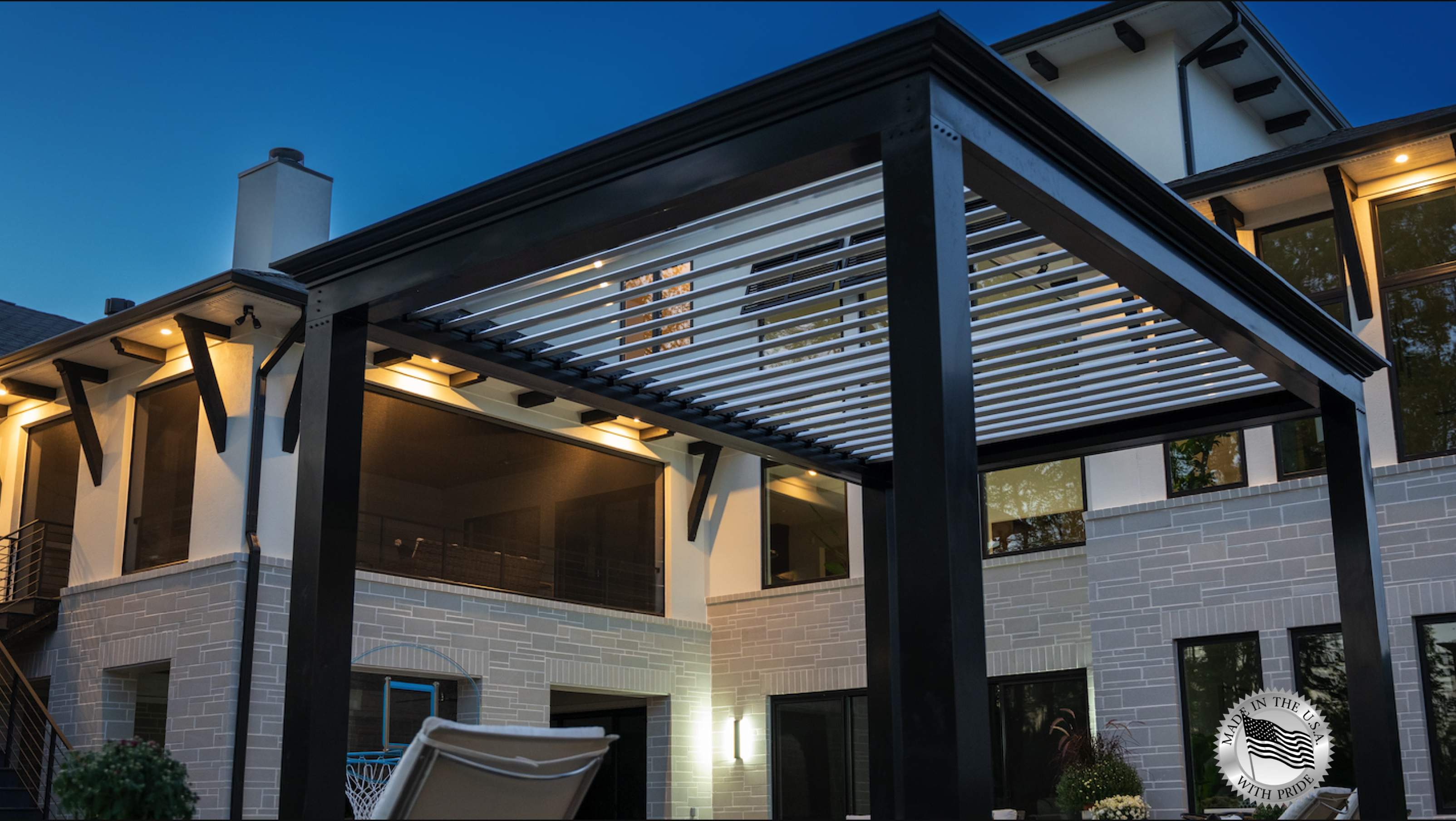
A modern louvered pergola uses a flat-ceiling design. The louvers sit in a recessed frame so the underside presents a clean, flat surface. It looks like a finished ceiling rather than an exposed mechanical system. This single detail transforms the visual experience of being under the pergola.
Concealed Hardware
Bolts, screws, brackets, wiring - in a modern pergola, all of this is hidden. The structure looks seamless, as if it was built from single pieces of material. This requires precision engineering and tight manufacturing tolerances. It is harder and more expensive to build, which is why most budget pergolas skip it entirely.
Integrated Systems
A modern pergola integrates its functional systems rather than bolting them on. Drainage channels are built into the frame, not hung below it as visible gutters. LED lighting is recessed into the beams rather than strung underneath. Wiring runs inside the posts. Motorized controls are hidden. Everything works, and nothing is visible.
Motorized Functionality
Manual operation is not modern. A truly modern pergola uses motorized louver adjustment, controlled by remote, wall switch, or smartphone app. Some include automated rain sensors and wind sensors that adjust the louvers without any input at all. The structure responds to the environment on its own.
The best motorized systems are silent and smooth, rotating louvers 130 degrees in seconds. You should be able to adjust your louver angle to any position between fully open and fully closed, not just toggle between two states. That precision control is what separates a modern pergola from a manual shade structure with a motor bolted on.
Modern Pergola Materials Comparison
Material choice determines both the aesthetic and the longevity of a modern pergola. Not every material can achieve a clean, contemporary look - and not every material that looks modern will hold up over time.
| Material | Modern Aesthetic | Maintenance | Lifespan | Motorized Louver Support | Cost Range |
|---|---|---|---|---|---|
| Aluminum | Excellent - clean extrusions, sharp edges, uniform finish | None (hose off yearly) | 25+ years | Yes - precision extrusions ideal for louver systems | $3,500 - $20,000+ |
| Steel | Good - can achieve clean lines but heavier profiles | Moderate - needs coating inspection, rust prevention | 15 - 25 years | Possible but uncommon | $5,000 - $15,000 |
| Wood (modern stain) | Moderate - can look modern with the right finish and geometry | High - stain/seal every 1-2 years | 8 - 15 years | Impractical - wood swells and contracts with humidity | $2,000 - $10,000 |
| Composite/WPC | Moderate - looks like wood, available in modern colors | Low | 15 - 20 years | No - insufficient structural rigidity | $3,000 - $8,000 |
# Aluminum, however, is the material of choice for contemporary pergolas.
Aluminum is the best choice for a new pergola. Extrusion technology lets us make very precise, clean extrusions that are not possible with wood or vinyl. Every edge is sharp. Every surface is flat. Every angle is exact.
Additionally, it is the only suitable material for louver systems that have power operators. Louvers must have tight tolerances in order to operate freely and properly seal when shut. Wood warps with changes in temperature and humidity. Composites deflect under load. Steel is possible, but much heavier and more costly to fabricate to the same tolerances. Extruded aluminum is manufactured for this purpose.
You add the benefit of zero maintenance, no rust, no rot, no repainting and a 25+ year lifespan and you have the material that delivers a modern look today, but still looks modern in 2045. See our full aluminum pergola guide.
Contemporary Pergolas
Modern has various sub-styles. They all give a sleek, up-to-date appearance, but their features and costs can differ.
Louvered (Adjustable Roof) - The Functional Choice for the Modern World
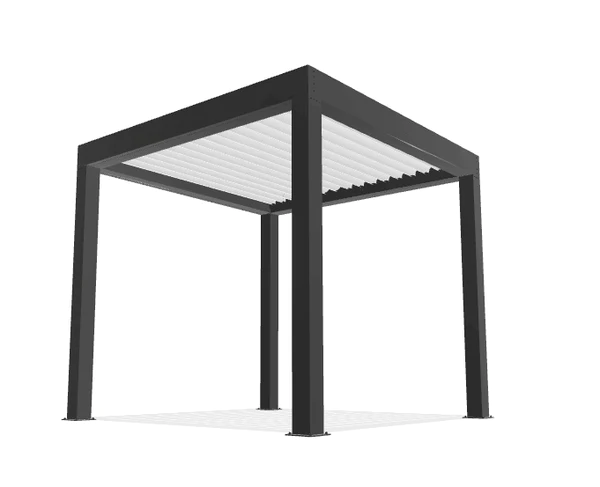
On a louvered pergola, the roof is composed of parallel slats that rotate from fully open (full sun) to fully closed (full shade and rain protection). The louvers can rotate 130 degrees or more, allowing you to dial in the exact amount of light you want to allow through at any given time.
A modern pergola with adjustable louvers is the most practical option for many homeowners as it can react to conditions. Full sun for your morning coffee. Shade in the heat of the afternoon. Rain coverage when the sky opens up. All from a single structure that requires no manual operation (when paired with sensors).
The flat ceiling louvered pergola represents the absolute pinnacle of contemporary pergola design. From underneath, it appears to be an elegant, minimalist roof. From above, it behaves like a smart outdoor living space. Check out our full louvered pergola guide.
Flat-Top / Solid Roof
A flat-top pergola has fixed aluminum roof panels that give you constant shade and rain cover. No moving parts. No louvers to adjust. The appearance is sleek and contemporary, a simple straight line over your patio.
The downside is the lack of flexibility. It offers 100% coverage, 100% of the time. You can’t ask for a open sky. This style works best for dedicated outdoor kitchens, pool houses, or spaces where permanent coverage is the goal.
Open-Beam Aluminum
Here’s the classic pergola design (open rafters) using contemporary aluminum. The rafters are smooth, squared aluminum rather than rough-hewn lumber. The overall effect is quite modern, with the same shade-only protection.
The least expensive type of aluminum pergola is the open-beam style, which also provides a very contemporary appearance. However, if maximum weather protection is your goal, an open-beam pergola won’t provide it.
Bioclimatic
“Bioclimatic pergola” is a name mostly used in European markets such as France and the rest of Southern Europe. It describes a pergola with louvers that adjust based on the climate; in other words, a louvered pergola. If you hear the term “bioclimatic,” you’re dealing with a louvered pergola from a European brand.
One such European bioclimatic brand is R-Blade. The designs are quite sleek with a modern look and feel but the availability and service is limited in North America compared to USA based companies.
# Here are the pergola design features that give this type of garden feature a modern look:
Two pergolas may be constructed from the same material and in the same general style, but they can still have a drastically different appearance based on design elements. The following are what make a pergola look modern versus non-modern.
When considering flat ceiling louver options, it’s important to keep in mind that these are distinct from exposed/curved ceiling louver designs. The primary difference is that exposed or curved louvers are usually mounted on the roof or wall exterior and are built to match the appearance and style of the structure. They typically include bird screens and do not have a roof covering them, meaning they are exposed to the elements.
Standing underneath a louvered pergola and looking up, you will either see a flat ceiling surface with no sign of the louver operation above, or the underside of the louver blades, their hinges, brackets, and spaces between.
The flat-ceiling technique is unmistakably modern. It allows the space under the pergola to feel like an outdoor room with a finished ceiling, rather than a mechanical device. This is a design element that most photos cannot capture, but is essential to living with the space.
HIDDEN MOUNTING HARDWARE
The number of visible bolts on a pergola: If they are visible, the pergola is not modern. A modern commercial pergola uses an internal fastening system. All of the connections are made inside the post and beam profiles. The exterior surface is solid aluminum.
# LED Lights
String lights hanging from a pergola aren’t contemporary. Recessed LED strips embedded in the beam profiles are. Today’s pergolas have factory-built lighting embedded in the aluminum channels, and are dimmable. You cannot see the light source. The result is a uniform warm luster over the ceiling.
Clean Post Profiles
The new pergola posts themselves are now just square or rectangular aluminum extrusions with sharp 90-degree edges and flat faces. That’s it. There’s no fluting, no tapering, and no base trim molding. The austerity is the feature. They do, however, house the wiring for the motor, lights, and sensors.
Black and Dark Finishes
The most common color for pergolas in today’s landscape is black. Black provides a sharp contrast with the sky, the foliage, and most house colors. It appears architectural and deliberate instead of natural.
Dark bronze and charcoal grey are also common modern choices. White is fine for a modern look if it's combined with contemporary architecture, however, in the modern pergola space, white is less common. Check out our black pergola and color selection guide.
Integrated Drainage
As a louvered pergola is closed, it forms a solid roof. Water falls on the roof. Water has to be channeled somewhere. Most economical pergolas will allow water to drip through the louvered gaps, or install gutters and downspouts underneath the pergola roof.
In new pergolas, the roof drains into the frame. When you close the louvers, water flows over the closed louver and into the beam channel, down the column and out at the bottom. No gutters, no downspouts, no drips and no signs of water management on the exterior of the column.

Modern Pergola Sizes and Configurations
Modern pergolas come in standard sizes and custom configurations. The right size depends on what you are covering and how you use the space.
Standard Sizes
| Size | Coverage Area | Best For | Approx. Starting Price (Commercial-Grade) |
|---|---|---|---|
| 10x10 | 100 sq ft | Small dining set, intimate seating area, balcony | ~$15,000 |
| 10x13 | 130 sq ft | Full dining area or seating group (most popular size) | ~$18,500 |
| 12x16 | 192 sq ft | Dining plus lounge, outdoor kitchen area | ~$22,000 |
| 10x20 | 200 sq ft | Long pool deck, outdoor kitchen, extended patio | ~$25,000 |
| Connected units (20x20+) | 400+ sq ft | Full outdoor living area, commercial applications | Custom pricing |
The 10x13 is the most common size for residential modern pergola projects. It spans a typical patio and offers enough square footage for a table and chairs or a sectional seating arrangement. You can also use our sizing guide to find the right dimensions for your space and figure out what size is best for you.
Freestanding vs. Wall-Mounted
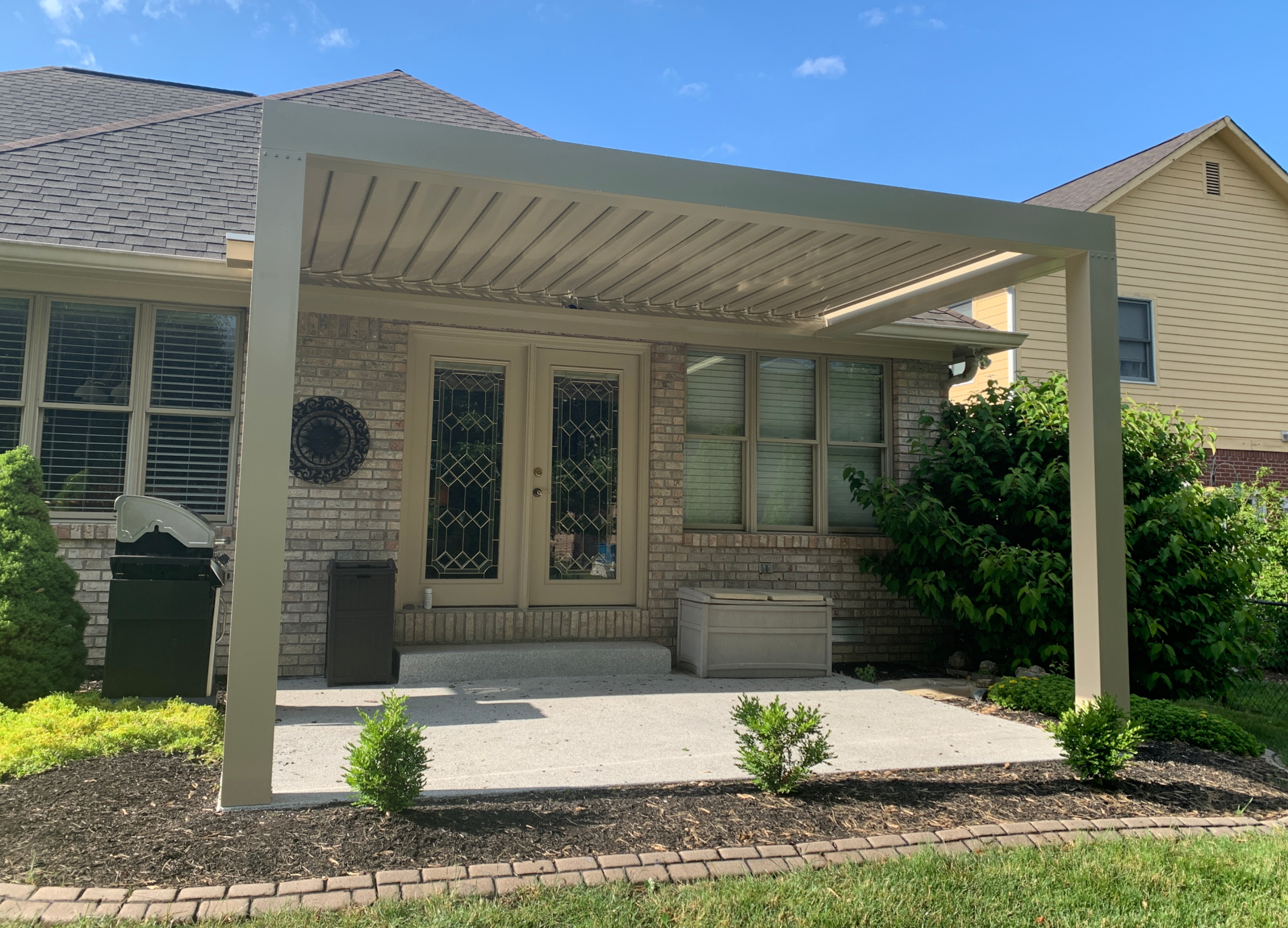
The modern pergola is a stand-alone structure that rests on four posts and may be located anywhere in your yard, patio, or deck. A pergola that is attached to your home is a more economical use of materials and creates a smooth visual transition between indoor and outdoor living spaces, requiring only two support posts.
Both styles are very contemporary if done right. The wall mounted style will generally appear more as a part of the house, which adds to the contemporary feel. And, fewer framing materials are needed, so it may be less expensive.
# Configuring Multiple Units
When you need to cover a bigger area, today’s pergolas can be joined together either side-by-side or end-to-end to accommodate spaces larger than the individual structure’s footprint. Where connected units meet, they share a post and form a contiguous roof that spans 400 square feet, 600 square feet, or more than 1,000 square feet.
This is the case for commercial use (restaurants, hotels, event spaces) and for large residential outdoor living spaces that contain independent cooking, dining, and lounging areas.
# How much does a pergola cost? If you’re comparing modern pergola prices to traditional pergola prices, there’s not a lot of difference. For a basic model, you can expect to pay between $3,000 to $10,000, while more advanced models with built-in lights, heaters, misting systems, and retractable canopies cost between $10,000 to $60,000 or more, depending on your choices of size, materials, and features.
The price can fluctuate wildly depending on the quality of construction, density of the material, and the way the product is distributed. Here is how the market breaks down for modern louvered pergolas, which is the majority of the modern pergola market.
| Category | Example | Price Range (10x13) | Weight | Wind Rating | Distribution |
|---|---|---|---|---|---|
| Budget (manual) | Costco Mirador | ~$2,000-$2,400 | ~300 lbs | 73-82 mph | Retail |
| Mid-range import | Various DTC brands | $6,000 - $9,000 | 400 - 700 lbs | 80 - 120 mph | Direct to consumer |
| Commercial-grade DTC | The Luxury Pergola | ~$18,500 | 1,800 lbs | Up to 200+ mph | Factory-direct |
| Commercial-grade dealer | StruXure | $30,000 - $55,000 | ~1,500 lbs | 157+ mph | Dealer + installer |
| Commercial-grade dealer | Azenco | $18,000 - $50,000+ | ~1,200 lbs | 175 mph | Dealer + installer |
The price differential between the commercial DTC offering and the dealer model is substantial. StruXure and Azenco make a great product, but the dealer-installer model adds 10k to 35k in markup on top of the product price. You’re paying for a sales process, a showroom, and for installation services, not for a proportionally superior product.
The Luxury Pergola meets or exceeds the same technical specs—and in some cases far exceeds them—at a much lower total cost because there is no middle man and no required install contractor. We ship directly from the factory in Indiana. See our full cost breakdown.
Pricing & What You’ll Really Get at Each Level
Under $5,000 (Costco Mirador and similar, manual louver adjustment): You will receive a modern appearing pergola that is very light (typically 300 lbs), has a low wind rating (73-82 mph), low snow load capacity (14-18 psf) and a short warranty (5 years). It appears modern in the picture. It will not function like a serious outdoor structure in bad weather. Expect a 5 to 8 year functional lifespan.
Mid-range imports ($6,000-$9,000): These have a better build quality. Thicker extrusions, nicer fit and finish, and better weather sealing. Still not commercial grade. They will work fine if you live in an area with a mild climate and don't have to worry about tornados and hurricanes.
$15,000-$25,000 (commercial grade DTC): Here you get commercial grade construction, without the middle man dealer. Our Luxury Pergola fits in this category: 1800 lbs, wind load 200mph+, snow load 65 psf+, ElectroLayer multi-stage powder coat, flat ceiling louver design, lifetime warranty. Built to the same standard as $40,000-$55,000 dealer channel products.
$30,000-$55,000 (commercial grade, dealer-installed): StruXure and Azenco make great commercial grade products. The extra cost is margin to the dealer, cost to operate a showroom, and cost to hire an installer. If you want to be completely hands-off and have someone else handle it all for you, then this is your range. If you are okay with handling the installation yourself (or organizing it yourself), you are over-paying for convenience.
The "Modern-Looking but Cheaply Built" Trap: How to Avoid It
This is the crucial part of this guide. Most of the pergolas you see on the market today look great but are poorly engineered. They look great in a photograph. They fall apart in year 3.
Here is how to tell the difference before you buy.
Check the Weight
Weight is the best gauge of quality. It shows how much aluminum is really in the frame. The more aluminum, the heavier the extrusions, the heavier the louvers, the heavier the posts and the heavier the connections.
- 250 to 450 lbs (10x13): Budget tier. Thin extrusions that look right in photos but flex when you push on them. These structures use the minimum material necessary to stand up, not the amount needed to handle serious loads or last decades.
- 500 to 900 lbs (10x13): Mid-range. Noticeably more substantial. Better louver seal, less flex, improved weather handling. A reasonable choice for mild climates.
- 1,500 to 1,800+ lbs (10x13): Commercial-grade. These structures are built like infrastructure. They do not move, flex, or rattle. They handle extreme weather without concern. This is the build quality that lasts 25+ years.
Get the shipping weight of the whole unit from the manufacturer. If they refuse to tell you, you have your answer.
10. Look for the Wind Rating
If your modern pergola comes flying apart in a wind storm, it’s not modern. It’s temporary. Most areas in the USA get wind gusts from thunderstorms in the range of 60-80mph. A pergola that’s rated to 55mph is already at its limit in everyday conditions.
- 55 to 80 mph: Budget territory. At risk in any serious storm.
- 80 to 130 mph: Mid-range. Handles most thunderstorms and weaker hurricanes.
- Up to 200+ mph: Commercial-grade. Every storm below a direct tornado strike is a non-event.
Our Luxury Pergola is engineered to 200+ mph. This means that a Category 5 hurricane, a derecho, or any pop-up thunderstorm you will ever have is well within its design criteria. Read our high-wind pergola guide.
Check the Snow Load
If you have a snowy climate this is important. Snow load is expressed in pounds per square foot (psf). A 10’x13’ pergola rated to 65 psf can hold over 8,000 pounds of snow. A 10’x13’ rated to 8 psf can hold about 1,000 pounds.
- 8 to 18 psf: Budget to mid-range. Adequate for areas with light, occasional snow.
- 55 to 65+ psf: Commercial-grade. Handles heavy, sustained snow loads without concern.
Inspect the Powder Coat
The finish is what will keep your pergola “modern”. Standard single-coat powder coat will begin to fade, chalk and wear in 3-5 years. Your nice black modern pergola, will now be a worn gray pergola.

Multi-stage powder coating processes - like The Luxury Pergola's ElectroLayer system - use electrophoretic deposition as a base layer followed by a UV-resistant top coat. This multi-layer approach resists fading for 20+ years. The black pergola you install today will still be black in 2045.
If a manufacturer cannot explain their coating process in detail, they are using standard single-stage powder coat. It will look great on delivery day and noticeably worse every year after.
Check the Warranty
A warranty is only meaningful if it covers the parts that actually fail. A "10-year warranty" on the frame alone is incomplete because the frame is the least likely component to have issues. The motor, electronics, louver mechanisms, and finish are the components most likely to need service.
Look for a warranty that covers:
- Frame (structural integrity)
- Louver blades and pivot mechanisms
- Motor
- Electronics (sensors, control systems, wiring)
- Powder coat finish (fading, chalking, peeling)
For example, the Luxury Pergola comes with a lifetime guarantee on the frame, louvers, motor, and electronics. That is what a real warranty looks like.
What Distribution Model is in place?
The distribution model doesn’t impact the quality of the build, but it has a huge impact on the price. When a pergola is sold through a dealer network and required professional installation, there’s between $10,000 and $35,000 of margin that has nothing to do with the product.
There are manufacturers who sell the same (or higher) quality product without the middleman markup. You can get a commercial-grade modern pergola for a small fraction of what a dealer would charge for a fully installed product. What you're sacrificing is having the installation handled for you, but when it's a product that is shipped with full instructions and all that is required to assemble is a drill and a ladder, that's an easy way to save tens of thousands of dollars.
Contemporary Pergola Designs According to Usage
Alfresco Dining for the Contemporary Era
The 10x13 or 12x16 louvered pergola with a modern roof covering a dining area serves as an outdoor dining space all year round. Open the louvers for a sunny brunch. Close them when it rains and you want to have dinner, and use the built-in LED lights in the evening to illuminate your outdoor space. This is the most frequent use case for a residential pergola and why the 10x13 is the best-selling size.
Modern Pool Area
The contemporary pergola is ideal beside a modern pool: It provides shade for a seating area while maintaining the open look of the pool area. The sleek aluminum framework fits in perfectly with the hardscaping (concrete deck, tile, glass) that is prevalent in modern pools. Use a 10x20, or multi-unit, for a full seating area.
# Nowadays, the term “outdoor kitchen” is used to describe an outdoor space with a much greater level of functionality. While it still includes an outdoor cooking surface, it also typically contains a refrigerator, sink, and eating area. In some cases, there may even be additional elements, such as a pizza oven, smoker, wet bar, or fireplace.
An outdoor kitchen needs a fixed roof to protect the appliances and countertops. A louvered pergola gives you that, but with the option to open up the roof to improve airflow when you are grilling. Plus, the gutters keep the rain from dripping on your countertops and appliances.
Commercial Space Today
Pergolas are being used in restaurants, hotels, event spaces, etc. to create covered outdoor seating areas that can be used 365 days a year. The engineering (200mph wind, 65 psf snow) ensures that it will be recognized as a structure that can be covered under the building code for commercial applications. Units are also connected to cover very large spans while still giving the space a very modern, clean look.
# Here is a modern take on the rooftop pergola. This structure offers a bit more coverage than a standard pergola, but it still allows in plenty of sunlight. It is perfect for hot, sunny climates. A modern style pergola like this is an attractive option for small rooftop spaces.
The most common and fastest growing use for the new-age pergola is as a rooftop structure. The issue here is that a rooftop receives more wind than ground level, and the structure will typically need to be mounted to the roof without putting holes in the roof membrane. An aluminum pergola, commercial in nature and having a wind load rating of over 200mph, is perfect for rooftop work due to the wind resistance they offer and the strength-to-weight ratio.
The louvered look is also a great fit for rooftop pergolas because often rooftop applications are more modern and city-centric. A black aluminum louvered pergola on a rooftop deck feels like it was meant to be there and not just something mounted on the side of the building.
# What are Pergola Accessories?
The pergola is the contemporary basis of the pergola. The features you install in the pergola are what will give the area its day to day functionality.
Retractable Screens
The zip screens or roller screens, which can be motorized, come down from the beam profiles to make walls if you want them. They keep out wind, bugs, and the low sun, and when rolled back up you retain the purity of the design (because they are contained within the beam). This converts the modern pergola into a fully enclosed outdoor space when you need it to be, and open when you don’t.
Infrared Heaters
For example, flush mounted infrared heaters can be inserted into the beam channels, allowing your modern pergola to be comfortably heated for more months out of the year in cooler areas, and all year in temperate climates, all without unsightly overhead units.
Ceiling Fans
A modern ceiling fan, which is rated for outdoor use, is attached to the louver frame to circulate air on calm days. To keep the space looking modern, select fans with simple, modern lines that are not fancy. They add to the modern atmosphere.
# Questions and Answers
What’s the newest pergola material?
Aluminum. Extrusion produces profiles that are sharper and flatter than any other material. Powder coated black or dark bronze and you have the unmistakable look of a modern pergola.
What is the price of a pergola today?
Louvered Pergola Price (kit): $2,000 (box store DIY) to $55,000 (commercial-grade, dealer-installed). Best value in commercial-grade pergolas is factory-direct: 10x10 starts at $15,000 and 10x13 starts at $18,500. Check our detailed cost breakdown for a full comparison.
What is the difference between a louvered pergola and a bioclimatic pergola?
Yes. “Bioclimatic” is what Europeans use to describe what we in America consider a louvered or adjustable pergola. The product is the same. Essentially, a pergola with louvers that adjust with the touch of a button to mitigate the sun, shade and rain. Europeans (R-Blade) use the term “bioclimatic.” Americans use “louvered.” Same difference.
Can I build a modern pergola on my own?
Pre-fabricated pergolas from modern companies are intended to be assembled and installed by the homeowner or a local handyman. All fasteners are included, along with instructions and everything has been pre-drilled. Installation usually takes a team of two to four people one to two days. No special tools or experience with pergolas is necessary. Electrical work for the motor and lighting should be done by a licensed electrician.
But do these newfangled pergolas stand a chance in cool climates?
They are suitable for all regions and climates. With a 65 psf snow load rating, they are capable of withstanding significant snow for extended periods. The powder coat finish will not crack and peel during freeze-thaw conditions. The motorized louvers can function in extremely cold and hot temperatures. If the manufacturer does not claim this, it is not a commercial grade product.
Let’s start with some definitions. What is a flat-ceiling louvered pergola?
The flat-ceiling louvered pergola is a pergola where the louver mechanisms are recessed above the finished ceiling height. So when you look up from below, you don’t see the ceiling of the louver blades above, but instead see a flat ceiling surface. This is what makes a louvered pergola look so room-like, and it’s really the defining characteristic of a louvered pergola.
What is the lifespan of a new aluminum pergola?
A commercial grade aluminum pergola using a high quality multi stage powder coating will last 25+ years with no maintenance. The aluminum will not rust, rot, warp or corrode. The multi stage powder coating will hold its color and not fade for 20+ years. The only maintenance is hosing it down once a year. A budget aluminum pergola using a thin extrusion and single stage powder coating will last from 5 to 12 years.
What color should you paint a contemporary pergola?
Black is by far the most popular pergola color for modern designs. It provides dramatic architectural interest, works with almost all home exteriors, and looks modern and deliberate. Dark bronze and charcoal also look great for modern pergolas. Read our full guide on black pergolas and color selection.
In what ways does the pergola of today differ from pergolas of the past?
A classic pergola will often have some ornamentation (e.g. arched corbels, chamfered ends, exposed fasteners, lattice roof) and is usually constructed of wood. A modern pergola is going to have simpler, cleaner design elements, hidden fasteners, less ornamentation, and modern materials (e.g. aluminum). Modern pergolas will also more commonly have automated louvers, water management, and LED lighting. The emphasis in design tends to be on function rather than form.
Related Guides
- Top Ideas for Your Outdoor Living Space That Elevate Your Home Experience
- Top Pergola Builder
- Corner Pergola
# Customize Your Pergola
The Luxury Pergola builds commercial-grade modern aluminum louvered pergolas in Indiana. Flat-ceiling louver design. ElectroLayer multi-stage powder coat. 1,800 lbs for a 10x13. Up to 200+ mph wind rating. Up to 65 psf snow load. 130-degree louver rotation. Lifetime warranty on frame, louvers, motor, and electronics. Factory-direct. No dealers, no installer markup.